General Information
Johannesburg is the most populous city in South Africa. The City of Johannesburg itself has a population of 5,538,596, while the City of Johannesburg Metropolitan Municipality has a population of 6,599,190, making it one of the 100 largest urban areas in the world. Johannesburg is the provincial capital of Gauteng, the wealthiest province in South Africa, and seat of the country's highest court, the Constitutional Court. Situated on the mineral-rich Witwatersrand hills, the city has long been at the epicentre of the international mineral and gold trade. The richest city in Africa by GDP and private wealth, Johannesburg functions as the economic capital of South Africa and is home to the continent's largest stock exchange, the Johannesburg Stock Exchange.
- Population: 5,900,000+ (Metro Area)
- Area: 1,645 km²
- Currency: South African Rand (ZAR)
- Coordinates: Latitude: -26.204444885254, Longitude: 28.045555114746
- Timezone: Timezone info not available
- Current Local Time: ailab
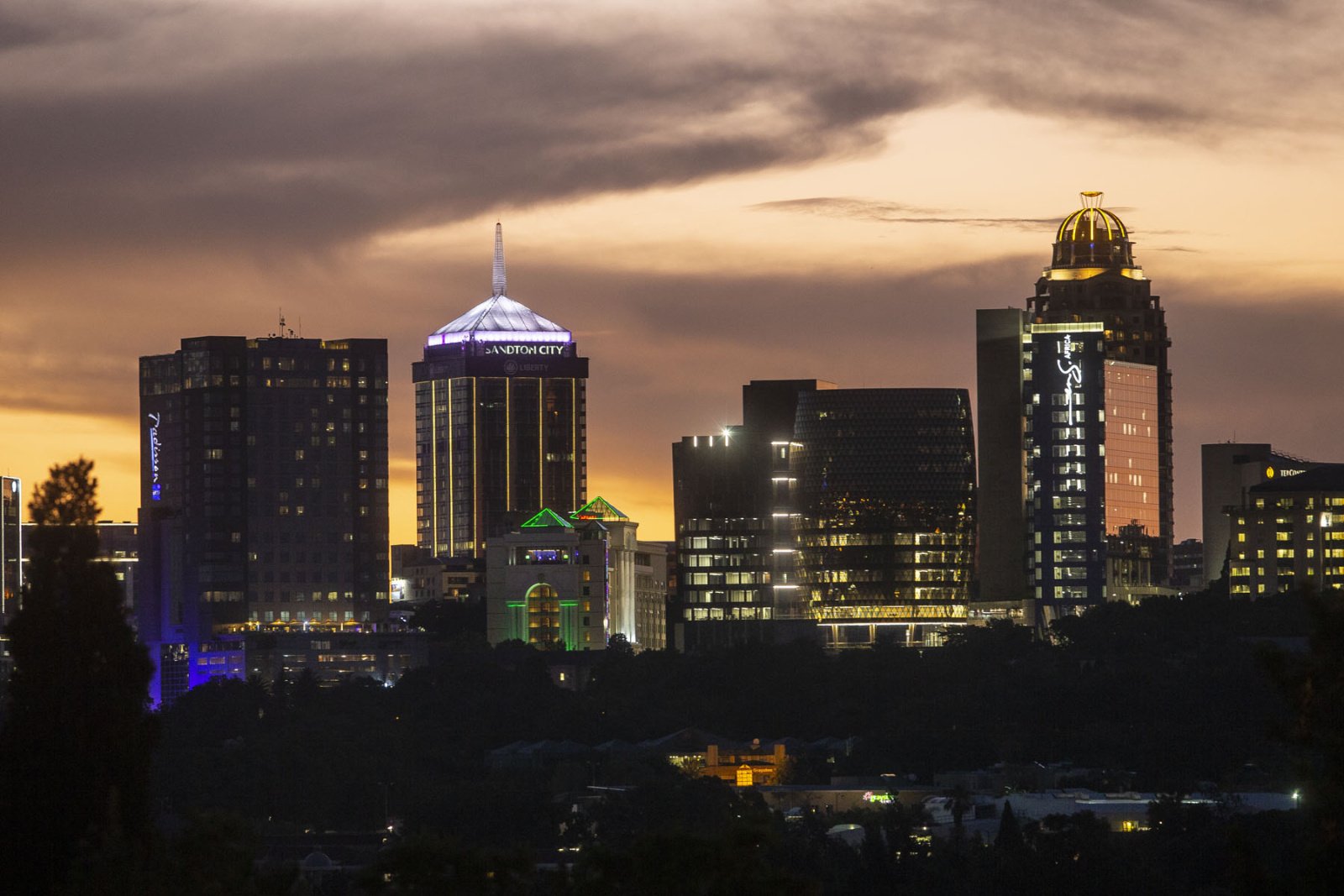
Sandton
Business towers, upscale malls, Nelson Mandela Square, and city nightlife.
Johannesburg CBD
Downtown streets, Commissioner Street, Gandhi Square, and real urban life.
Soweto
Township streets, Maponya Mall, Protea North, and cultural walking tours.
Rosebank & Melrose Arch
Shopping areas, nightlife, and modern mixed-use districts.
Johannesburg Latest News
IOL
Read in full: Minister Enoch Godongwana delivers medium-term Budget Speech
South Africa’s Medium-Term Budget Policy Statement was tabled by Finance Minister Enoch Godongwana in Parliament on Wednesday afternoon.
IOL
Young Stunna dedicates sophomore album 'Busisiwe' to the woman who shaped his life
Young Stunna has dedicated his 16-track sophomore album, Busisiwe, to his late great-grandmother, celebrating the woman whose influence shaped his music, fashion and journey to stardom.
The Citizen
Godongwana on GBVF: Billions for social workers, courts and care centres
National Treasury’s response to gender-based violence and femicide (GBVF) will come in the form of funding for more sexual offences courts and an increase in care centres. At least R4 billion will be allocated to entities dealing with the causes and consequences of GBVF, with the cash injection doubling as job creation. Minister of Finance Enoch Godongwana announced the GBVF interventions while presenting his 2026 Medium-Term Budget Policy statement on Wednesday. The additional funding for GBVF, and the other financial adjustments made by Godongwana, were made possible through a tightening of administrative belts. “Targeted and responsible savings exploit the trade-offs we are making in improving the quality of spending and funding pressures. “We are phasing out programmes that are no longer fit for purpose. We are also restructuring underperforming and inefficient programmes, and reducing administrative inefficiencies and fraud in programmes,” Godongwana told the National Assembly. ‘No reason for complacency’ The minister said he was delivering on instructions from the executive and responding to the sentiment expressed by the country as a whole. “Mr President, in September you announced decisive measures to address crime and violence against women. “We are making additional resources available to implement these measures, but this progress is no reason for complacency,” stated Godongwana. The minister confirmed that R3.8 billion would be made available to employ 3 500 social workers to “strengthen prevention” of GBVF attacks. Forensic and investigative capacity will be bolstered by the injection of R186 million, while R157 million would be given to the Department of Women, Youth and Persons with Disabilities to improve “oversight of government’s response to GBVF”. Godongwana said the number of specialised sexual offences courts would be increased from 55 to 101, with Thuthuzela Care Centres increasing from 72 to 80 – although those numbers are targets for 2029. Over 18 million grant recipients As well as support for those vulnerable to GBVF, Godongwana stated that social expenditure remained a key feature of government spending. “The fiscal space created through disciplined budgeting allows us to protect frontline services, preserve the jobs of teachers, doctors and nurses, while protecting the social wage for the most vulnerable,” said the minister. He confirmed that health, education, shelter, and social development would account for 60% of non-interest expenditure. This included free basic electricity, water, sanitation and waste management to 11 million poor households, and the funding of subsidised education and nutrition for 77% of school children. Improving prenatal care and the first three years of a child’s life through anti-stunting and malnutrition programmes will also receive an extra R1.6 billion. “The budget also funds a comprehensive social safety net of old-age, disability and child support, and other social grants to 18.1 million beneficiaries,” said Godongwana. ‘Bounce back better and faster’ Treasury made space for the reforms by identifying R38 billion for reprioritisation across the 2027 medium term, and R12 billion in the 2026 budget. Undisclosed “low-priority programmes”, duplicated functions and limiting administrative inefficiencies accounted for R11 billion of that amount. Reducing social grant fraud freed up R13 billion, while R5 billion was sourced via public entity surpluses. A further R7.8 billion was identified in the human settlements development grant, where “programme inefficiencies and rent seeking” were rife. “Despite global volatility, South Africa is weathering the storm much better than its peers because we have been able to consistently take hard decisions over the last five years that have built our fiscal buffers and fortified our resilience. “We are able to bounce back better and faster,” Godongwana concluded.
The Citizen
Tshwane water crisis: EFF asks Public Protector to probe chlorine failure that left hundreds ill
EFF treasurer general Omphile Maotwe has lodged a complaint with the Public Protector, asking it to investigate the City of Tshwane over a chlorine failure that left more than 408 people ill in Bronkhorstspruit and surrounding areas. The office confirmed receipt of the complaint on Wednesday “The Office of the Public Protector hereby acknowledges receipt of your correspondence dated 8 October 2026 concerning the complaint submitted to this office,” chief investigator Adv. E De Waal wrote in response to Maotwe. The letter said the matter would first be assessed for jurisdiction. “Upon completion of this assessment, the appropriate communication regarding the outcome and any further steps will be conveyed to you,” De Waal stated. What went wrong at the Bronkhorstspruit plant The City of Tshwane has admitted that it did not chlorinate water from the plant between 24 September and 14 October. On Monday, residents supplied by the Bronkhorstspruit Water Treatment Works were warned not to drink tap water or use it for cooking or bathing after an investigation confirmed the water is contaminated, resulting in more than 400 cases of gastrointestinal illness. According to reports, the city also did not warn residents. Maotwe argued that the problem was one of management. “The failure was administrative before it was anything else,” Maotwe said. She named Mayor Nasiphi Moya and City Manager Johann Mettler as respondents. “A municipality that runs out of chlorine for three weeks, and tells no one, has failed in the most elementary duties of public administration,” she argued. The plant resumed operating on 16 October, but residents were told tap water was still unsafe. The city deployed 36 water tankers from Cullinan. “Entire communities remain without safe tap water,” Maotwe stated. Remedies Maotwe wants Maotwe asked for independent testing of the water and free tanker supplies until it was safe. She also demanded compensation for affected households, disciplinary action against responsible officials and a chlorine contingency plan. She said she had also opened a criminal case with police and filed a complaint with the South African Human Rights Commission. Maotwe maintained that the Public Protector is best placed to investigate the matter. “I request the Public Protector to investigate the conduct described above and to take appropriate remedial action in terms of section 182(1)(c) of the Constitution,” Maotwe said. “No other body is investigating these questions, and only the Public Protector can take binding remedial action on them.”
The South African
‘Increase the grant’: Pensioners call for more as SASSA brings November payday forward
Pensioners are expressing frustration over the value of their monthly grant. At the same time, SASSA has made an important change to their November payment. Grant recipients shared their concerns in the comments section of The South African’s Facebook page. Many said the Older Persons Grant no longer covers their basic needs. Donovan Serfontein said government has turned its back on older South Africans. “People died poor with nothing left for their children and yet the Government is not concern or worried about the nation,” Serfontein wrote. November SASSA grant moves forward Pensioners will not have to wait for the first week of November to get paid. Under SASSA’s revised arrangements, the Older Persons Grant will be paid on Friday, 30 October, with the Disability Grant following on Monday, 2 November and the Children’s Grants on Tuesday, 3 November. The agency said the revised schedule follows consultations with stakeholders to keep grant payments running efficiently and securely during the Local Government Elections on 4 November. SASSA has also set aside Thursday, 5 November, for beneficiaries whose grants are under review. The agency urged beneficiaries not to visit its offices unnecessarily, as payments will be processed according to the announced schedule. Early money, longer wait An early payment may feel like relief, but it comes with a catch. December’s Older Persons Grant is expected on 2 December. That leaves pensioners stretching their November money over more than a month. This is the same grant that many pensioners already say is too small. The Older Persons Grant pays R2 400 per month to recipients 60 and older. Pensioners who plan their spending carefully in the first week will be better placed to reach December without running short. Calls for more support continue The date change does nothing to address the main concern raised by grant recipients. Many want either more money or lower costs. Enock Thembekile Jakeni wants SASSA to step in at the till. “SASSA should issue card to pensioners to get 25% discount in stores & Supermarket,” Jakeni wrote. Shipho Khosi said government should choose one of two options. “Either discount at shopping stores or increase in the pension,” Khosi wrote. SASSA has not announced plans for either proposal. Win R2 000 in the South African SASSA grant survey If you receive a SASSA grant and want to share your story, we want to hear from you. Take part in our survey and stand a chance to win R2 000. Your responses help us tell the stories that matter.
The South African
R38 billion by 2030: What MTBPS said about SASSA grants
Millions of recipients of SASSA grants were waiting with bated breath to glean any positive news from today’s (Wednesday 21 October) 2026 MTBPS. And Finance Minister Enoch Godongwana debuted a new term we’ll probably be hearing a lot: ‘targeted and responsible savings.’ 2026 MTBPS ON SASSA GRANTS On top of the R12 billion identified for SASSA grants in the February 2026 Budget, Treasury has unlocked a further R38 billion over the 2027 medium-term period. For clarity, this period spans a three-year fiscal horizon from 2027/28 through to 2029/30. Moreover, the minister says R13 billion of that is to come from ‘reducing fraud.’ From there, the 2026 MTBPS shares little detail on where and how this additional money will be allocated. Nevertheless, on a straight-line basis, R13 billion spread over three years is about R4.3 billion a year. And let’s not forget R1.33 billion in irregular payments was flagged by the Auditor-General this past financial year. Our takeaway is that South African Social Security Agency reviews, eLife certification and biometric matching will not only stay, but increase in voracity, to meet these targets. SOUTH AFRICA’S SOCIAL SAFETY NET More will be spent on the first 1 000 days of children’s lives through feeding schemes. Image: File Godongwana reiterated that South Africa’s social wage is one of the most comprehensive on the continent. Spending on healthcare, education, SASSA grants, social development and housing, makes up 60% of government non-interest expenditure. “The budget funds a comprehensive social safety net for old-age, disability and child support to 18-million ‘core’ beneficiaries,” he said. Moreover, government is allocating R1.6 billion over the 2027 medium-term period (till 2030) to focus on prebirth care. This means the first 1 000 days of life, aimed at tackling stunting and malnutrition. It isn’t a grant increase per say, but it does mean more help to Child Support SASSA grants. TACKLE HIGH COST OF LIVING While not directly related to SASSA grants, a few measures to tackle the high cost of living crushing South Africans were addressed. Specifically, the fuel levy will be cut by R3 a litre for diesel and R1.50 for petrol from November to December 2026. Then by R1.50 for diesel and R1 for petrol until January 2027. That’s R10 billion in forgone revenue for the Central Energy Fund (CEF). Frustratingly, 2026 MTBPS made no mention of the ‘expanded SRD grant’ that’s supposed to morph into some kind of Basic Income Support for the nation’s unemployed. Even though Godongwana kicked that can down the road back in February 2026. As we know, the ‘temporary’ R370 grant is funded only until 31 March 2027. Perhaps the R38 billion allocation in his speech is what it’s earmarked for? And finally, no word on the potential trajectory of future grant increases in 2027 either … But what do you think? Do you like what you heard from the minister about SASSA grants in his 2026 MTBPS? Please share your thoughts in the comments section below …
TechCentral
Treasury backs down on crypto rules after ‘thousands’ of comments
Enoch Godongwana says the draft cross-border rules need "a different approach" and a second version is coming.
TechCentral
Godongwana cuts fuel levy again, with diesel getting the bigger break
Diesel's levy drops by R3/l and petrol's by R1.50/l from 4 November, at a cost of R10-billion in tax revenue.