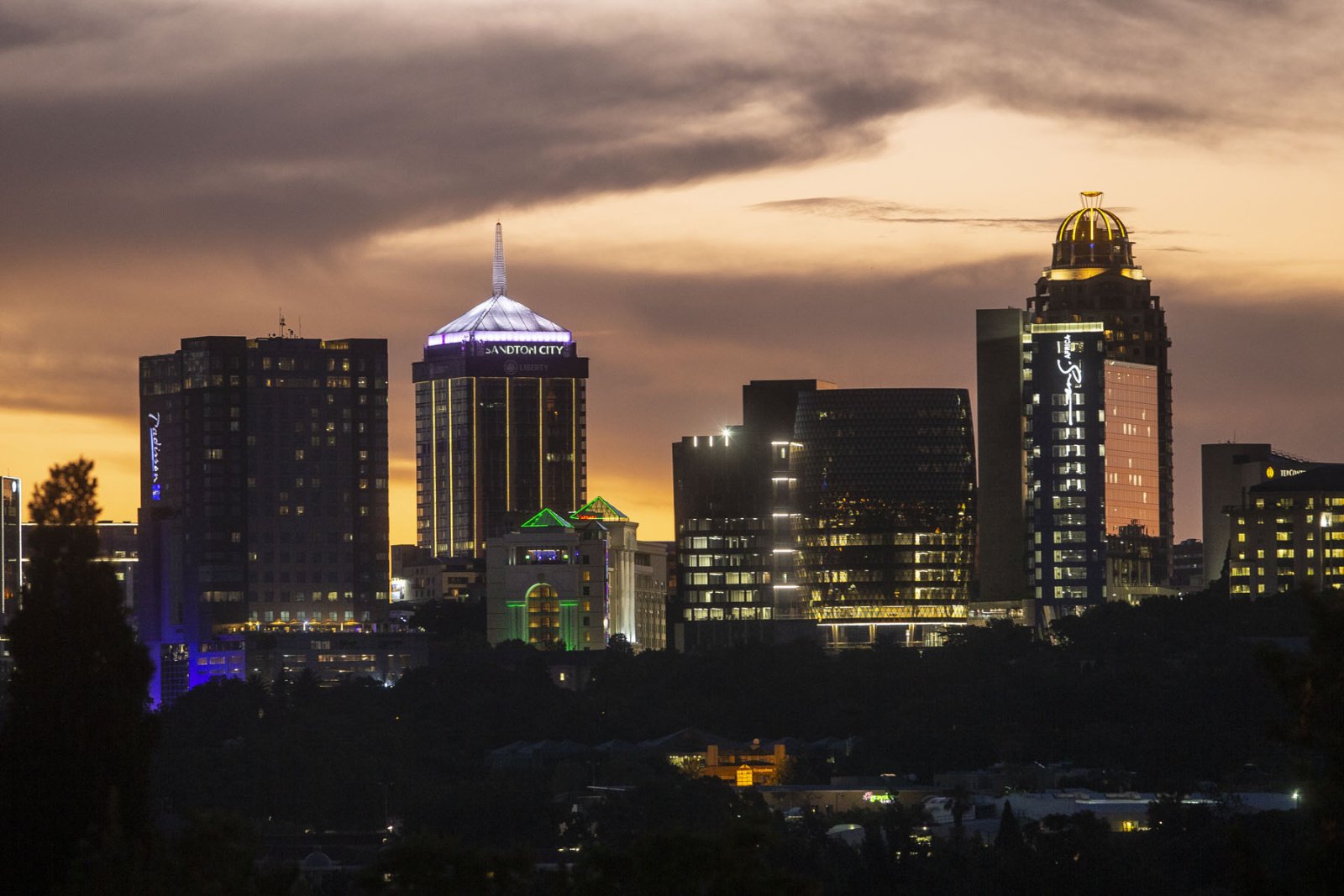
General Information
Johannesburg is the most populous city in South Africa. The City of Johannesburg itself has a population of 5,538,596, while the City of Johannesburg Metropolitan Municipality has a population of 6,599,190, making it one of the 100 largest urban areas in the world. Johannesburg is the provincial capital of Gauteng, the wealthiest province in South Africa, and seat of the country's highest court, the Constitutional Court. Situated on the mineral-rich Witwatersrand hills, the city has long been at the epicentre of the international mineral and gold trade. The richest city in Africa by GDP and private wealth, Johannesburg functions as the economic capital of South Africa and is home to the continent's largest stock exchange, the Johannesburg Stock Exchange.
- Population: 5,900,000+ (Metro Area)
- Area: 1,645 km²
- Currency: South African Rand (ZAR)
- Coordinates: Latitude: -26.204444885254, Longitude: 28.045555114746
- Timezone: Timezone info not available
- Current Local Time: ailab
Sandton
Business towers, upscale malls, Nelson Mandela Square, and city nightlife.
Johannesburg CBD
Downtown streets, Commissioner Street, Gandhi Square, and real urban life.
Soweto
Township streets, Maponya Mall, Protea North, and cultural walking tours.
Rosebank & Melrose Arch
Shopping areas, nightlife, and modern mixed-use districts.
Johannesburg Latest News
IOL
WATCH: Make easy boondi ladoos at home this Diwali
Aunty Babez shares an easy boondi ladoo recipe made with gram flour, coconut, almonds and a sticky sugar syrup.
IOL
Ottosdal couple make history with same-sex URCSA wedding
Thuso Lobeko and Kagiso Maine were married in a ceremony described as the first same-sex wedding in the URCSA’s Ottosdal Presbytery.
The Citizen
Ramaphosa deploys 510 soldiers to KZN amid violence linked to Refugee Act misinformation
President Cyril Ramaphosa has authorised the deployment of 510 South African National Defence Force (SANDF) members to KwaZulu-Natal (KZN), which is estimated to cost R34 million. The deployment is expected to support police efforts amid escalating unrest linked to misinformation surrounding a Constitutional Court judgment on the Refugee Act. Deployment Ramaphosa has informed parliament that he decided to deploy soldiers to maintain law and order amid recent violence in the province. The deployment will see SANDF members support the South African Police Service (Saps) under Operation Prosper from 9 October 2026 until 30 November 2026. The soldiers will be monitoring the anti-illegal immigration protests that have been taking place in parts of KZN, including Durban. Intervention Presidential spokesperson Vincent Magwenya said the military intervention was necessary following violent incidents linked to a campaign of misinformation surrounding a Constitutional Court judgment on the Refugee Act. “The members of the SANDF will assist the Saps in maintaining law and order in KZN, especially in light of recent violent actions arising from a campaign of misinformation about the Constitutional Court judgment on the Refugee Act,” Magwenya said. Soldiers on standby Magwenya said the deployment is intended to bolster policing operations and ensure security forces are prepared for any potential escalation of unrest. “The members of the SANDF will be on standby to support the police for any eventuality that may occur,” he said. Cost The Presidency has formally notified National Assembly Speaker Thoko Didiza and National Council of Provinces Chairperson Refilwe Mtsweni-Tsipane of the deployment. Magwenya said the deployment will remain in force until the end of November, with government projecting expenditure of just over R34 million. The Presidency maintains that the SANDF will work with and support Saps operations in KZN as authorities seek to contain violence and preserve stability in the province.
The Citizen
After shutting stores, Pick n Pay now plans to trim the size of others
Retailer Pick n Pay will continue to trim space across its store estate after a reset plan saw it shut dozens of loss-making stores in the last three years. It will do this as leases come up for renewal. Because the group doesn’t disclose its total footprint (area), it is not clear how extensive this is. In the six months to 30 August, its occupancy costs declined by 2.6% on a normalised basis. CEO Sean Summers says “there are a lot of stores that are still too big and not fit for purpose” and that he doesn’t “think it’s any different for most retailers that are out there today that run big store estates”. He offers a few examples, including a “classic” at Kenilworth Centre around a kilometre from its head office. He says the store is “about” 6 000m2 in total currently and it could “literally halve that store”. “We could take 2 500m2 [or] 2 800m2, and I can tell you now, we’d run a better business with far less wastage. And we may still [do] even more turnover, ironically.” Landlord engagement Summers says the group has been seized with discussions with landlords to get the stores to appropriate sizes. According to Summers, new CFO Tina Rookledge put the team “to the sword the other day and made them do [an] analysis” and that team was shocked that they had “actually achieved a lot”. “We’re getting to lease renewals – that’s where we’re really focused, in terms of repurposing our stores.” Summers offers another example in the big-box Hypermarket division: Brackenfell. “You know, that store in its current construct, just size-wise, can never ever do enough sales again to warrant having a building that big,” he says. “I think our GLA [gross lettable area] is about 14 000m2. I mean … it’s nuts.” He says the group has to get to the point where it works with landlords to completely reconfigure the centre, much like its doing at Faerie Glen in Pretoria East. Summers says as part of that project, the entire centre will “be redeveloped and we’ll end up with what we call the ‘New Age Hyper’ now – about 6 500m2 and the balance of the other eight or nine thousand square metres “will be redeveloped in the centre”. In that centre, a new 3 000m2 Woolworths Food will open, along with other line shops. Capex In the first half, Pick n Pay spent R300 million on capex, in line with the amount for its subsidiary, Boxer. In the second half, this will increase to R1.4 billion, which according to Rookledge, will be prioritised to “revamping strategic stores”, “certain franchise acquisitions that make sense for the business” and “critical repairs and maintenance as well”. Typically, capex is weighted to the second half across both Pick n Pay and Boxer. Summers says there are a number of “big stores as well” that will be renovated next year, including the V&A Waterfront and Canal Walk. Store footprint Pick n Pay added a net five supermarkets to its estate in the six months to 30 August, as a result of acquiring a number of franchise outlets (for a total of 290). In the franchise division, this number declined to 207, 11 less than six months ago. Summers says the “pace at which developments are currently taking place in the country has definitely dropped off… there’s only so many areas you can continue to open stores”. He says many of the decisions made by the Shoprite group in term of store openings would’ve gone back to “most probably four or five years ago”. This article was republished from Moneyweb. Read the original here.
The South African
The most expensive South African road trips this December
For many South Africans, the December holidays mean loading up the car and heading to the coast or travelling home to visit family. But with long distances, fuel prices and toll fees to consider, some of the country’s most popular festive-season road trips can cost thousands of rand before accommodation, food and activities are added. We have compared some of the most popular long-distance routes between South Africa’s major cities and holiday destinations to give motorists an idea of what they could spend. The estimates are based on a vehicle using 7 litres of fuel per 100km and October 2026 petrol prices. The actual December 2026 fuel price is not yet known, so these figures should be treated as estimates. Popular December road trips compared RouteApprox. return distanceApprox. driving timeEstimated return fuelEstimated return tollsEstimated return fuel + tollsDurban – Cape Town3 460km17 hrsR7 100R230R7 300Johannesburg – Cape Town2 800km14–15 hrsR5 930R500R6 430Johannesburg – Gqeberha2 120km11 hrsR4 500R400R4 900Durban – Gqeberha1 800km10 hrsR3 700R100R3 800Durban – Johannesburg1 140km6 hrsR2 350R650R3 000Cape Town – Gqeberha1 500km8 hrsR3 100R150R3 250Cape Town – Plettenberg Bay1 040km6 hrsR2 140R160R2 300Cape Town – Knysna980km5 hrs 30 minR2 020R80R2 100Cape Town – George860km4 hrs 45 minR1 770R130R1 900Cape Town – Mossel Bay780km4 hrs 30 minR1 620R80R1 700 Estimates are for a return journey in a vehicle using 7 litres/100km. Fuel calculations use October 2026 petrol prices. Actual December fuel prices, toll tariffs, vehicle consumption and route choices may affect the final cost. The longest trips can quickly become expensive The figures show how much the cost of a road trip can vary depending on where you’re travelling from and to. The Durban-Cape Town route is by far the most expensive of the popular routes compared, with an estimated return fuel and toll bill of around R7 300. The Johannesburg-Cape Town route follows at approximately R6 430, while motorists travelling from Johannesburg to Gqeberha could spend around R4 900 on fuel and tolls for the return journey. At the other end of the table, Cape Town motorists travelling to popular Mossel Bay could expect to spend around R1 700 on the return trip based on the assumptions above. Families can split the cost While thousands of rand may sound expensive, the cost looks different when several people are travelling in the same vehicle. For example, a R7 300 return trip split between four people works out at approximately R1 825 per person for fuel and tolls. This is one reason driving can still make financial sense for families and groups travelling during the festive season. However, motorists should remember that fuel and tolls are only part of the cost. Long-distance travellers may also need to budget for overnight accommodation, meals, parking and additional driving once they reach their destination. These routes can also take considerably longer during the festive season. Motorists should allow extra time for congestion, roadworks, accidents and rest stops, particularly on the country’s major holiday routes. Drivers tackling the longest journeys should also plan regular breaks and avoid trying to cover excessive distances without stopping. ARE YOU PLANNING A ROAD TRIP THIS DECEMBER? IF SO, WHERE ARE YOU HEADING TO? LET US KNOW IN THE COMMENTS BELOW.
The South African
Painted on lace: The young South African artist taking Paris by storm
South African artist Buqaqawuli Nobakada is making her mark in Paris. Instead of canvas, she paints on lace. And her first solo exhibition in France is now on view in one of the world’s art capitals. Buqaqawuli Nobakada’s exhibition, Our Dreams Began to Chase Us Back, opened on Monday, 19 October, at Galerie Pierre Cornette de Saint Cyr in Paris’s 8th arrondissement. It runs until 19 December 2026. 🇿🇦 Buqaqawuli Nobakada paints Black women’s dreams on her grandmother’s lace curtains, now she has her first solo show in Paris 📍Galerie Pierre Cornette de Saint Cyr pic.twitter.com/JgMKhaRRJh— Horde (@wearehorde_) October 22, 2026 WHAT’S IN BUQAQAWULI NOBAKADA’S PARIS SHOW? The exhibition presents six new works. It’s curated by Destinee Ross-Sutton, and presented by Ross-Sutton Gallery in partnership with Pierre Cornette de Saint Cyr. The show opened during Art Basel Paris 2026, a major international art fair week. PAINTING ON LACE Nobakada, sometimes called “The Lace Lady”, paints with acrylic on hand-prepared lace. The texture of the lace flows through the figures, clothing and interiors in her paintings. Her work portrays Black women in moments of dance, rest and togetherness, in lush gardens, beside pools and in elegant interiors, rather than in stories of struggle or trauma. According to her gallery biography, she centres hyper-femininity as a space of power and self-determination, affirming that Black women belong in spaces of grandeur and shape their own futures. FROM WITS TO THE WORLD STAGE Nobakada was born in 2000, and studied Fine Arts at the University of the Witwatersrand in Johannesburg. Her work has quickly gained international attention. In 2025, she held a solo exhibition at the Albany Museum of Art in the US state of Georgia, and showed at the 1-54 Contemporary African Art Fair in London. In 2026, her work has also appeared at EXPO CHICAGO and in group exhibitions in South Africa and abroad. CAN YOU SEE THE EXHIBITION? Our Dreams Began to Chase Us Back is on view at Galerie Pierre Cornette de Saint Cyr, 29 avenue Franklin-D.-Roosevelt, Paris, until 19 December 2026. WHICH SOUTH AFRICAN ARTISTS DO YOU THINK DESERVE MORE INTERNATIONAL RECOGNITION? Let us know in the comments below…
TechCentral
Governing AI in African markets: from principles to practice
Africa Tech Festival's Kadi Diallo argues for adaptable AI rules that suit each market's level of readiness.
TechCentral
Ethiopia leaves South Africa in the dust on electric vehicles
South Africa outscores Germany, the US and the UK in a new electrification index. But the country is doing poorly in EV adoption.