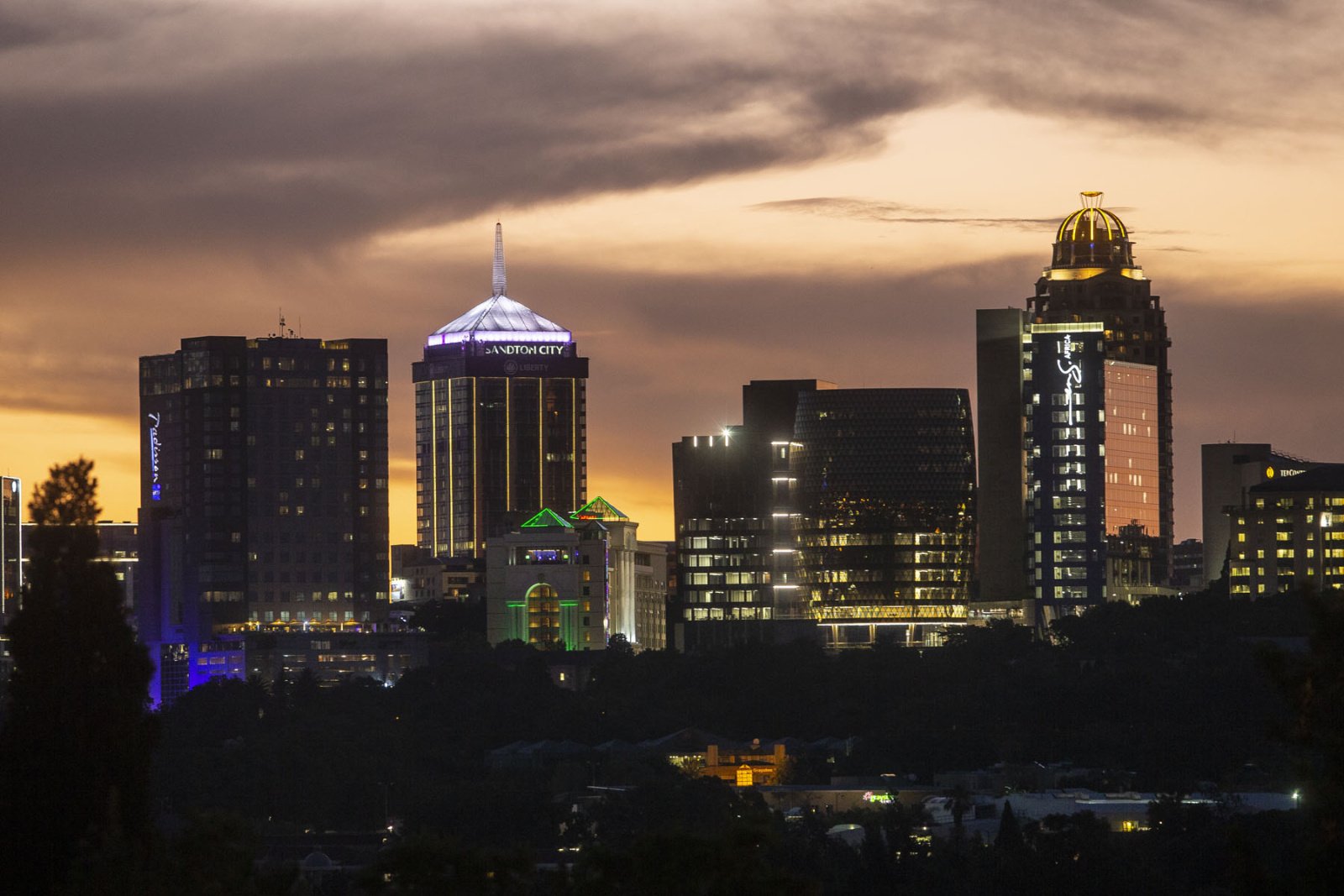
General Information
Johannesburg is the most populous city in South Africa. The City of Johannesburg itself has a population of 5,538,596, while the City of Johannesburg Metropolitan Municipality has a population of 6,599,190, making it one of the 100 largest urban areas in the world. Johannesburg is the provincial capital of Gauteng, the wealthiest province in South Africa, and seat of the country's highest court, the Constitutional Court. Situated on the mineral-rich Witwatersrand hills, the city has long been at the epicentre of the international mineral and gold trade. The richest city in Africa by GDP and private wealth, Johannesburg functions as the economic capital of South Africa and is home to the continent's largest stock exchange, the Johannesburg Stock Exchange.
- Population: 5,900,000+ (Metro Area)
- Area: 1,645 km²
- Currency: South African Rand (ZAR)
- Coordinates: Latitude: -26.204444885254, Longitude: 28.045555114746
- Timezone: Timezone info not available
- Current Local Time: ailab
Johannesburg Latest News
IOL
The arrest and death of Ahmed Timol at John Vorster Square
Ahmed Timol was arrested with Salim Essop in October 1971 and died in police custody four days later. This account traces his final movements, the arrests that followed and the conflicting findings about his death.
IOL
Aussies seek batting fix as Carey warns against solo acts
" Convert those starts": Carey calls out fragile Aussie batting line-up ahead of final Test
The Citizen
Ramaphosa takes credit for Madlanga Commission, says ANC did not betray SA
President Cyril Ramaphosa says his government is now focusing on rebuilding the South African police service after discovering that it had been infiltrated by criminal elements. He was speaking while out on the election campaign trail in Johannesburg on Sunday. He said that when he came in as president his administration had already identified several state institutions that were going rogue and needed intervention. He said now he had established the Madlanga Commission to identify weaknesses in the police service. “Now, when we set up this commission, many people dismissed it, saying there is Cyril Ramaphosa again. He is always setting up commissions, and this was a very clear and deliberate move on my part to make sure that when we do rebuilding, we do it in a way that, when we set up systems, they are going to be sustainable for the future,” he said. The Madlanga Commission was formed after intense public scrutiny and calls for action following KwaZulu-Natal police commissioner, Lt-Gen Nhlanhla Mkhwanazi’s explosive media briefing exposing allegations of political interference and collusion inside the SA Police Service. Ramaphosa said government will also focus on rebuilding the country’s intelligence services. “Minister Ntshavheni has been so deeply involved in rebuilding our intelligence services; we are rebuilding the South African Revenue Service (SARS); we are rebuilding the police because many of us do not remember the terrible period that we went through; the Zondo Commission recommendations are being implemented. “We are passing laws, and now the Madlanga Commission is getting people arrested, because that is what we said we wanted,” he said. Ramaphosa said more still needs to be done to deal with corruption. “We are going to continue dealing with corruption, and this is a process of rebuilding our country, repositioning it whether they like it or not. We are going to rebuild South Africa, to make it a South Africa that is going to bring about a better life for all our people,” he said. He said rebuilding key state institutions is critical for economic growth and good governance. “What we have been seeking to do is to ensure that there is proper governance in those institutions,” he said. Have the ANC betrayed SA? Ramaphosa denied that his party had betrayed the people of South Africa. The ANC has been in government since 1994. “A generation is 30 years. In a generation we have been able to turn around 340 years of colonialism and apartheid rule in just 30 years. Just think about that. “They took 340 years or so to destroy our country, to destroy its capability, to strip our people of assets, to ensure that they are not well educated. “In 30 years and one generation, we have been transforming this country which the apartheid and colonial misrulers destroyed our country. They made our economy operate on two cylinders and not on six cylinders,” he said.
The Citizen
Ramaphosa points to fuel levy relief as cost-of-living crisis bites
President Cyril Ramaphosa says the government’s temporary fuel levy relief is part of broader efforts to ease cost-of-living pressures on households, and argues that South Africa’s improving public finances must ultimately lead to better services, jobs and economic growth. Last week, Finance Minister Enoch Godongwana responded to South Africans’ call for relief by reducing the fuel levy. While delivering his medium-term budget policy statement (MTBPS) on Wednesday, Godongwana said the fuel levy will be reduced by R3 per litre for diesel and R1.50 per litre for petrol from 4 November 2026 to 1 December 2026. It will then continue at lower amounts until 5 January 2027, with the diesel levy reduced by R1.50 per litre and the petrol levy by R1 per litre. Financial strain In his weekly newsletter after last week’s MTBPS, Ramaphosa acknowledged the financial strain many South Africans face. “We know the rising cost of living is putting a massive strain on households. The temporary reduction in the fuel levy announced by the minister is one of the ways we are trying to provide some relief,” he said. The president said the country has made progress in stabilising its finances after years of rising debt, which he said had diverted resources away from essential services and infrastructure. “As our debt went up, so did the cost of paying interest on it. Every rand we spent on interest was a rand that couldn’t be used to build a school, build houses, equip a hospital, fix a road or provide essential services,” Ramaphosa said. Debt According to the president, public debt has now stabilised and is beginning to decline for the first time in nearly two decades. He said the government has maintained a primary budget surplus since 2023, allowing it to reduce borrowing costs and direct more resources to development priorities. Fiscal challenges Ramaphosa linked many of the country’s fiscal challenges to state capture and the Covid-19 pandemic, which put additional pressure on public finances. He said government is focusing on improving spending efficiency, reducing waste and reviewing underperforming programmes. “Fixing our finances isn’t just about collecting more tax or cutting debt. It is also about making sure every single rand of public money is spent wisely, honestly and effectively,” he said. The president said more than R11 billion in savings had been identified by rationalising lower-priority programmes, and reforms are also underway to improve infrastructure delivery and oversight. Economic challenges However, Ramaphosa cautioned that stronger public finances do not mean South Africa’s economic challenges have been resolved. “We know that many South Africans haven’t felt the benefits of this economic recovery yet. Unemployment is still far too high, too many families are struggling to get by and too many communities are dealing with poor services,” he said. Ramaphosa said the government’s job now is to turn financial stability into economic opportunity and a “better quality of life for everyone”.
The South African
Kaizer Chiefs rumours: Maboe, Da Cruz future, McCarthy, new wonderkid
Today’s Kaizer Chiefs news wrap looks at Lebohang Maboe’s fitness, Fernando Da Cruz’s future, Aden McCarthy’s lucky transfer twist and Steven Mendes’ rise to the first team. Did McCarthy get lucky? Following a winter move to Azerbaijani outfit Sabah FK, it’s been a steady growth curve for 22-year-old defender Aden McCarthy. The former Kaizer Chiefs man scored his first goal in Europe’s elite club competition, the Champions League, on Wednesday night in Sabah’s 1-2 defeat to Borussia Dortmund. Sabah beat Slavia Praha 2-0 on matchday 2, their first ever win in the competition. Some local online chatter speculates that McCarthy earned his big move to Sabah because his agent has a strong European passport, and therefore has easier access to contacts on the continent. It’s a theory, for sure. Kaizer Chiefs playing catch-up and it’s October After just eight games of the new Betway Premiership campaign, Kaizer Chiefs are already trailing leaders Sundowns by nine points, and Orlando Pirates by eight. They’ve only triumphed in one of their last seven clashes across all competitions. With just a solitary piece of silverware in the last 10 years (a Nedbank Cup triumph in last year’s final against Pirates), it’s difficult to escape the conclusion that Chiefs are horribly underachieving, given their fanbase and huge financial might. If results don’t improve quickly, it’s easy to envisage Da Cruz being sacked before Christmas. If they’re out of contention for CAF Champions League football, that should be the final nail in his coffin. Next up for the Glamour Boys is a Nedbank Cup clash against TS Galaxy at Soccer City on Tuesday, 27 October at 19:00. Playmaker Lebohang Maboe is still unavailable through injury. Mendes is one to watch for Kaizer Chiefs 18-year-old Steven Mendes won the Golden Boot at the recent COSAFA U20 tournament in Maputo, Mozambique. Mendes, nominally a midfielder, was converted into a striker for the event. He’s nicknamed ‘Stevie G’ by some teammates and could feature for the senior side sooner rather than later. After all, Vela Khumalo knows what he’s talking about when it comes to talented youngsters. Will Chiefs sack Da Cruz before Christmas? Add your thoughts by clicking the red comments banner below!
The South African
Applying for a digital nomad visa? The paperwork that could get you rejected
Digital nomad visa requirements can trip up even the most organised South African. Working from a beach or a mountain cabin sounds simple. The paperwork isn’t. And one missing document could be enough to get your application rejected. Here’s what could get you rejected: most digital nomad visas ask for proof of income, health or travel insurance and proof that you work remotely. Some also ask for extra documents that many applicants only discover at the last minute. A VALID PASSPORT It sounds obvious, but it catches people out. The Department of International Relations and Cooperation (DIRCO) advises that South African passports should be valid for at least six months after your return date, with at least two blank pages. For a long stay abroad, check your passport’s expiry date against the full length of your planned visa, not just your flight dates. PROOF OF INCOME Most nomad visas set a minimum monthly income. For example, Namibia’s digital nomad visa requires at least $2,000 (about R32,900) a month, according to the Namibia Investment Promotion and Development Board (NIPDB). Applicants usually need to prove their income with documents such as: recent bank statements, payslips, or contracts with clients, if you’re a freelancer. Make sure your statements clearly show regular income that meets the country’s minimum. PROOF THAT YOU WORK REMOTELY Nomad visas are designed for people who work for employers or clients based outside the country they’re visiting. You’ll usually need to prove this, for example with: a letter from your employer confirming that you can work remotely, your employment contract, or contracts with international clients. In Namibia’s case, applicants must work for companies or clients based outside Namibia. HEALTH OR TRAVEL INSURANCE This is one of the most common reasons applications fall short. Many countries require insurance that covers your entire stay, not just your first few weeks. Georgia, for example, has required all tourists to have health and accident insurance, with minimum cover of GEL30,000 (about R181,000), since 1 January 2026, according to Georgia’s Ministry of Foreign Affairs. Border officials check it on arrival, and visitors without a valid policy can be refused entry. Before you buy a policy, check: the minimum cover the country requires, that the policy covers the full length of your stay, and that it covers medical emergencies, not just lost luggage or flight delays. OTHER DOCUMENTS YOU MIGHT NEED Depending on the country, you may also be asked for: a police clearance certificate, which can take several weeks to get from the South African Police Service (SAPS), proof of accommodation, such as a rental agreement, documents for family members, if they’re travelling with you, or proof of funds to support yourself during your stay. Some countries also require official documents to be legalised, which you can arrange through DIRCO. TIMING MATTERS Some programmes require you to apply well before you travel. Seychelles, for example, asks remote workers to apply for its Visitors Workcation Permit at least two weeks before travelling. Start gathering documents early, since things like police clearance certificates and legalised documents can take weeks. DIGITAL NOMAD VISA REQUIREMENTS: DON’T FORGET TAX Before you go, check how working abroad could affect your tax. If you remain a South African tax resident, the South African Revenue Service (SARS) can still tax your worldwide income, although you may qualify for an exemption on part of it. HAVE YOU EVER APPLIED FOR A VISA TO WORK REMOTELY ABROAD? Let us know in the comments below…
TechCentral
MTN and Huawei claim industry first in microwave spectrum reuse
The solution cancels co-channel interference, helping MTN expand backhaul capacity at constrained sites.
TechCentral
Former Icasa chairman Paris Mashile has died
Paris Mashile led Icasa's fight to cut mobile termination rates, and admitted when the regulator fell short.