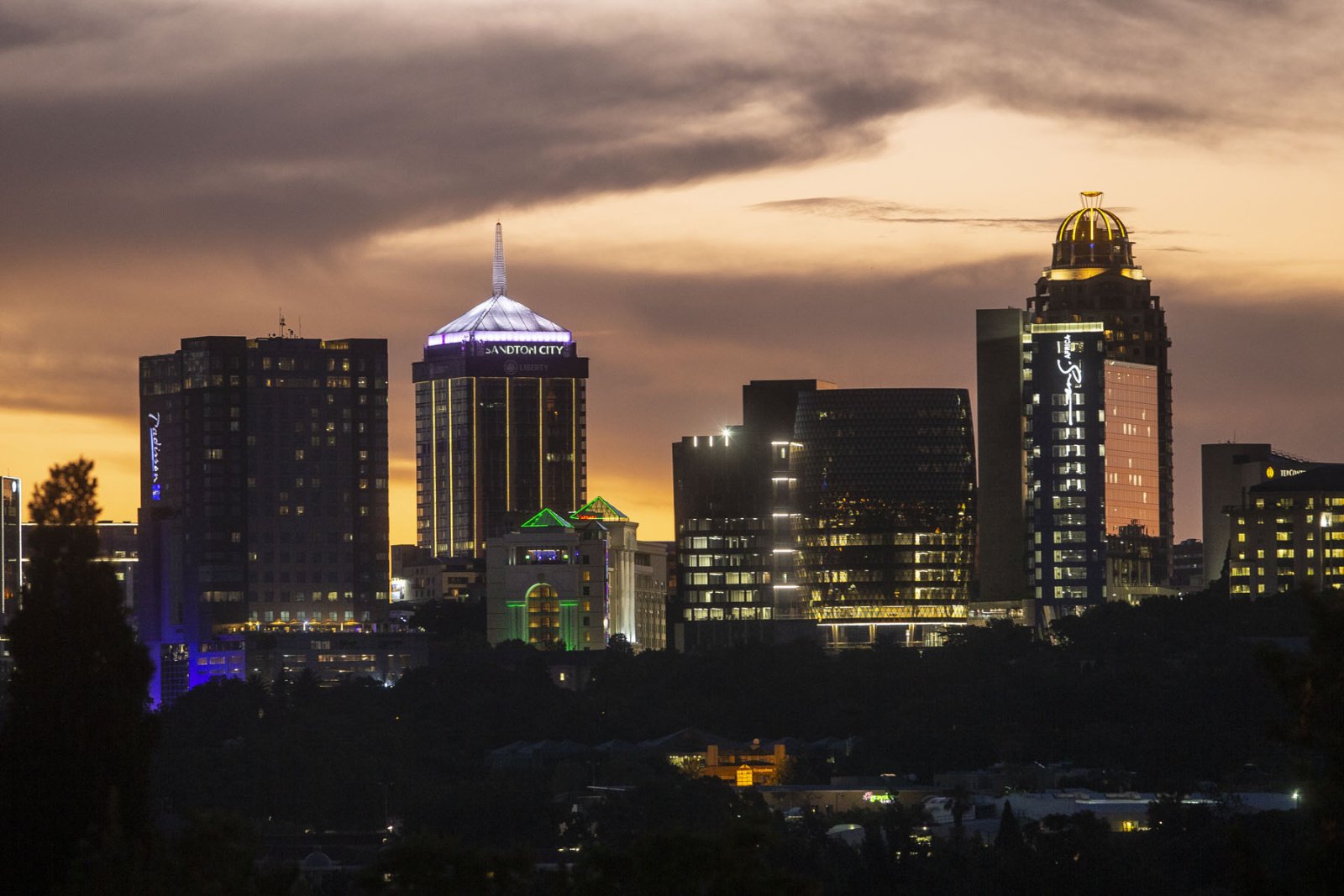
General Information
Johannesburg is the most populous city in South Africa. The City of Johannesburg itself has a population of 5,538,596, while the City of Johannesburg Metropolitan Municipality has a population of 6,599,190, making it one of the 100 largest urban areas in the world. Johannesburg is the provincial capital of Gauteng, the wealthiest province in South Africa, and seat of the country's highest court, the Constitutional Court. Situated on the mineral-rich Witwatersrand hills, the city has long been at the epicentre of the international mineral and gold trade. The richest city in Africa by GDP and private wealth, Johannesburg functions as the economic capital of South Africa and is home to the continent's largest stock exchange, the Johannesburg Stock Exchange.
- Population: 5,900,000+ (Metro Area)
- Area: 1,645 km²
- Currency: South African Rand (ZAR)
- Coordinates: Latitude: -26.204444885254, Longitude: 28.045555114746
- Timezone: Timezone info not available
- Current Local Time: ailab
Sandton
Business towers, upscale malls, Nelson Mandela Square, and city nightlife.
Johannesburg CBD
Downtown streets, Commissioner Street, Gandhi Square, and real urban life.
Soweto
Township streets, Maponya Mall, Protea North, and cultural walking tours.
Rosebank & Melrose Arch
Shopping areas, nightlife, and modern mixed-use districts.
Johannesburg Latest News
IOL
Twelve dead, including five children, as Joburg-bound bus overturns on N1, Free State
A bus travelling from Cape Town to Johannesburg overturned on the N1 in the Free State, killing 12 people and injuring 66 others as investigators probe the cause of the crash.
IOL
ANCWL to Put Ramathuba in the Hot Seat Over ‘Ben 10’ Remarks
The ANC Women's League (ANCWL) has distanced itself from controversial remarks by Limpopo Premier Phophi Ramathuba linking the downfall of women leaders to relationships with younger men, saying it will engage with her over the comments.
The Citizen
South Africa is better placed for looming El Niño, experts say
The looming El Niño which is expected to hit the country towards the end of the year, could be the worst on record, meaning droughts and high temperatures across southern Africa. This is along with major impacts on a South African economy already struggling with the effects of the Middle East war and the closure of the Strait of Hormuz. Caution urged over El Niño forecasts But as farmers and government, as well as relief agencies, plan their responses to extreme weather, experts say the country is in a relatively good position to ride out the tough times. The most recent bad drought in South Africa was in 2015-16, when farmers lost thousands of head of livestock, thousands of hectares of grazing and crop yields plummeted because of the heat and lack of rain. AgriSA chief operating officer Jolanda Andrag cautioned against assuming the predicted El Niño would have an impact similar to the 2015-16 drought. “The first point to make is that we are dealing with a seasonal forecast rather than a confirmed drought,” she said. While the predicted El Niño warrants careful monitoring, Andrag added that “the intensity, timing and geographical extent of any impacts remain uncertain”. “It is equally important not to view this season through exactly the same lens as the 2015-16 drought [because] South Africa is entering the 2026-27 production season from a fundamentally stronger position,” she said. Record harvest offers a crucial buffer Andrag pointed out that the country is expected to harvest a record summer grain and oilseed crop of approximately 21.5 million tons, including the largest maize harvest on record at an estimated 17.25 million tons. “This provides ample grain supplies, significant carry-over stocks and a strong buffer against potential production shortfalls,” Andrag said. TLU chair Bennie van Zyl said it was difficult to determine which areas will be hit the hardest and what the impact will be. “We have experienced much more severe El Niño events in the past, yet farmers in certain areas still managed to produce above-average harvests, so it is hard to predict how things will play out. “Yes, we are going to have warmer weather, but the major problem might be the lack of well-distributed rainfall,” he added. Van Zyl said there was currently a five million ton maize surplus expected once the crop is harvested this year. “In some cases, moisture levels remained too high, preventing farmers from harvesting.” Van Zyl noted that this was the second consecutive year with a five million ton maize surplus, set against South Africa’s average annual consumption of 12 million tons. Soil moisture expected to aid farmers Agricultural economist Wandile Sihlobo said: “While it is understandable that many people worry about the expected El Niño, forecasts of higher food price inflation may miss some of the fundamental issues that will shape the season ahead, such as improved soil moisture and available grain supplies. “South Africa has benefited from a prolonged La Niña, which has supported the agricultural sector over the past few years. The rainfall periods have also been much longer than the typical periods.” Sihlobo said the crop estimates committee’s latest projections were revised higher and still point to a record summer crop harvest for 2025-26. “The longer rainfall season benefited the country by improving soil moisture and the water table ahead of the 2026-27 summer crop season,” he said. “When the planting period starts in October 2026, farmers across South Africa will have better than normal soil moisture to begin with. There may be sufficient soil moisture to support seed germination and crop development across the country, even as El Niño conditions are likely to result in below normal rainfall.” Meteorological facts El Niño is characterised by a warming of ocean surface temperatures in the central and eastern equatorial Pacific. It typically occurs every two to seven years and lasts around nine to 12 months. It generally begins developing between March and June and reaches its peak intensity between November and February, with impacts on global temperatures typically being most pronounced in the second year after development. The effects of each El Niño/La Niña event vary depending on the intensity, duration, time of year when it develops and also how it interacts with other climate variability modes. Not all regions of the world are affected and even within a region, impacts can be different.
The Citizen
‘Clicky Ponting’ saga proves that it is just not cricket
The screaming tabloids in the UK are absolutely loving the story about the club cricketer supposedly caught cheating by clicking his fingers to simulate a batsman getting an edge or a nick, and then getting caught behind. They’ve gagged on their clever headlines, too. “Clicky Ponting” quickly became the nickname for Saltburn’s first slip fielder, one Brian Devine, who was the man identified in the video. Apparently, he’s been at it for a while, because the team has racked up more than 30 “caught behind” catches this season and an amazing eight in one innings… where the elite record is said to be just seven. I suppose it was Devine Intervention, indeed… and the Daily Mail can have that one for free. The next turn in the saga was one of outrage – that “the media” (there’s that term again… for every whinger who needs someone to blame) had been hounding poor Brian and making his life a misery. British hacks have a way of going for the jugular and the Daily Mail went as far as contacting his relatives… which many said was “going too far” because Brian had “just made a mistake”. That, to quote a Youtuber I watch, is like saying: “Your wife was walking past and I slipped and fell into her vagina…” It’s not only Brian who’s culpable here: Any cricket fan will tell you that this sort of serial cheating could only have happened with the knowledge of the bowler, wicketkeeper, probably other fielders and possibly even the captain. Saltburn issued a statement, seeming a bit wounded that it was being subjected to such a spotlight, but at the same time saying the club would investigate and that Devine had been suspended. Apology? No, mate… This is funny in a way – especially because it goes to the heart of the saying “that’s just not cricket” in the heart of the game the English themselves invented – but also raises a far more serious question of morality in sport and in broader society. With the distasteful displays of the Argentina team at the World Cup still fresh in the memory, there was a social media chat (before Clicky Ponting emerged from the covers – haha) about honest German footballer Miroslav Klose, who once confessed to scoring a goal with his hand. In a September 2012 match between Lazio and Napoli in Italy’s Serie, Klose nudged the ball into the net with his hand and after the referee initially allowed the goal, Klose told the official it hit his hand. The referee cancelled the goal and Klose later received a fair play prize for his honesty. In 2005, while playing for Werder Bremen, he asked the referee to revoke a penalty incorrectly awarded to him. That makes him stand out like a sore thumb in the footie world, where the balletic diving and acting remind one more of Swan Lake than any real nutcracker… Should we be upset at Devine, though? If you believe in the “broken windows” principle, then yes, we should. If we tolerate minor offences, we create the atmosphere for bigger ones. That was the motivation, supposedly, of New York City police commissioner William Bratton in the 1980s when, as he cracked down on petty crime, major offences also dropped like a stone. Wrong is wrong, surely, and should not be excused by its scale. It’s as wrong to park in a disabled bay as it is to fake your student loan application to National Student Financial Aid Scheme, or to loot billions from a government hospital budget.
The South African
Madlanga Commission: A week that shook IDAC
Former Investigating Directorate Against Corruption (IDAC) head Advocate Andrea Johnson dominated another week at the Madlanga Commission. She resigned. She returned to the witness stand. She then faced fresh allegations from one of her own prosecutors. The commission continued probing allegations of criminality, political interference and corruption within South Africa’s criminal justice system. Johnson resigns Johnson resigned as head of the Investigating Directorate Against Corruption (IDAC) on 26 July. President Cyril Ramaphosa accepted her resignation with immediate effect the following day. Johnson returned to the witness stand on 28 July. Although she no longer led the directorate, she remained under subpoena. Evidence leaders continued questioning Johnson about IDAC’s investigation into senior Crime Intelligence officials. They asked whether the directorate acted within its legal mandate and whether investigators followed proper processes. The commission also examined why IDAC pursued some allegations while others allegedly never reached Johnson’s desk. Johnson told the inquiry she had not been briefed on those matters. She defended the directorate’s handling of the investigation and denied any wrongdoing. Commissioners compared her evidence with documents and testimony from previous witnesses as the inquiry continued. Ramsamy challenges Johnson The inquiry then heard from IDAC prosecutor Drushantha Ramsamy, who worked on the Crime Intelligence case alongside the directorate’s leadership. Ramsamy became the first serving IDAC prosecutor to give first-hand evidence about how the case against Lieutenant-General Dumisani Khumalo and Brigadier Dineo Mokwele was built. She disputed parts of Johnson’s testimony and challenged her account of key decisions taken during the investigation. Ramsamy alleged Johnson personally drove an investigation known as Project Diversion, which targeted National Police Commissioner General Fannie Masemola and Khumalo. She also claimed Johnson handed her a list of suspects after discussions with senior investigators. Johnson has previously denied wrongdoing. Secret recording played Ramsamy said she secretly recorded the conversation. The commission played the recording during Thursday’s proceedings. According to Ramsamy, Johnson told her: “If the Madlanga Commission calls you, you must leave the country.” The recording formed part of Ramsamy’s evidence as she challenged Johnson’s version of events. Commissioners will now assess the competing accounts alongside documentary evidence and testimony already before the inquiry before making findings. What’s next? The commission will continue hearing evidence as it investigates allegations of criminality, political interference and corruption within South Africa’s criminal justice system. President Cyril Ramaphosa has extended the commission’s reporting deadline to 16 November 2026.
The South African
Missing EFF member found dead in bushes near Delmas
The Gauteng Political Killings Task Team has found the body of missing Economic Freedom Fighters (EFF) member Aaron Makola in Mpumalanga. According to the police, Makola’s body was found on Thursday in Delmas. #sapsHQ ]GAUTENG POLITICAL KILLINGS TASK TEAM FINDS BODY OF MISSING EFF MEMBER]The Gauteng Political Killings Task Team (GP PKTT) has found the body of an Economic Freedom Fighters (EFF) member, 51-year-old Aaron Makola who was reported missing in Bronkhorstspruit.According… pic.twitter.com/OnoxUOpQiJ— SA Police Service 🇿🇦 (@SAPoliceService) July 30, 2026 Makola was reported missing in Bronkhorstspruit on 10 July 2026 and his vehicle was found a day after his disappearance. BODY RECOVERED National Spokesperson Brigadier Athlenda Mathe said the preliminary investigations indicated that Makola was shot and killed before his body was dumped in a bush. The task team investigated the matter on 20 July after meeting with his family and obtained new information linked to the case. Mathe confirmed that the deceased has been identified by his family. INVESTIGATION The motive for the killing is still unknown at this stage and the police have indicated that investigations are at an advanced stage, with efforts underway to identify and arrest those responsible for the murder. “Investigations are at an advanced stage to identify and apprehend those responsible for the murder, including both the perpetrators and any individuals who may have orchestrated the crime,” said Mathe. FATHER AND SON KILLED IN ALLEGED HOUSE ROBBERY Meanwhile, the police in Free State have launched a manhunt after a father and his son were killed in their home on Thursday. The Virginia police received a complaint of a possible murder at a property in Tulbagh Street. Upon arrival, the members were directed to the outside room where they found the bodies of the victims. #sapsFS [SUSPECTS SOUGHT BY POLICE FOLLOWING A DOUBLE MURDER IN VIRGINIA]The Free State Provincial Murder and Robbery Unit based in Thabong have launched investigations into an alleged murder and house robbery incident. This is after a father and his son were discovered… pic.twitter.com/Ve6sjcFG0K— SA Police Service 🇿🇦 (@SAPoliceService) July 30, 2026 ROBBERY Police spokesperson Sergeant Palesa Thabana said the victims were found with both their hands and feet tied. “Two victims were found with both their hands and feet tied. There was blood on the floor. One victim was further discovered with a plastic cover over his head. While the other victim was strangled with a wire around his neck,” said Thabana. The victims were declared deceased on the scene. Police said the victims’ silver Hyundai Getz was allegedly stolen during the incident. Police have urged anyone with information that could lead to the arrest of the suspects to visit their nearest police station.
TechCentral
How Chinese cars took over South African showrooms
Chinese brands have gone from fringe players to a fifth of South Africa’s new-vehicle sales.
TechCentral
The retailer that is about to become your bank
Why Pepkor's PlusB is the most credible challenge Capitec has ever faced, and what it will take to prove it.