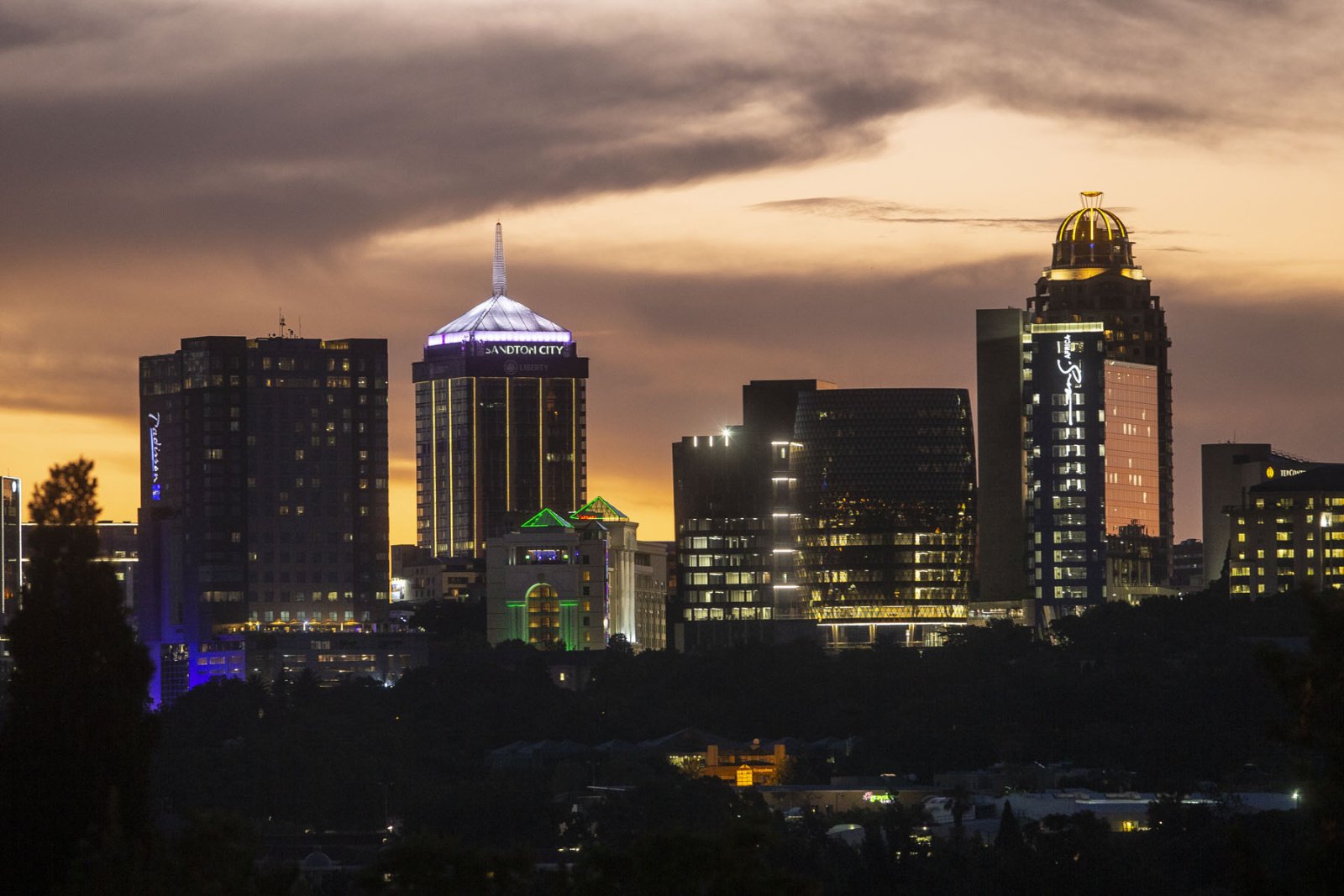
General Information
Johannesburg is the most populous city in South Africa. The City of Johannesburg itself has a population of 5,538,596, while the City of Johannesburg Metropolitan Municipality has a population of 6,599,190, making it one of the 100 largest urban areas in the world. Johannesburg is the provincial capital of Gauteng, the wealthiest province in South Africa, and seat of the country's highest court, the Constitutional Court. Situated on the mineral-rich Witwatersrand hills, the city has long been at the epicentre of the international mineral and gold trade. The richest city in Africa by GDP and private wealth, Johannesburg functions as the economic capital of South Africa and is home to the continent's largest stock exchange, the Johannesburg Stock Exchange.
- Population: 5,900,000+ (Metro Area)
- Area: 1,645 km²
- Currency: South African Rand (ZAR)
- Coordinates: Latitude: -26.204444885254, Longitude: 28.045555114746
- Timezone: Timezone info not available
- Current Local Time: ailab
Johannesburg Latest News
IOL
SAMA32 Best R&B Soul Album nominees revealed as Langa Mavuso, lordkez and Gemma Fassie battle for glory
Discover the nominees for the Best R&B Soul Album at the 32nd South African Music Awards, featuring heartfelt projects from Gemma Fassie, Langa Mavuso, lordkez and others.
IOL
New PIC board puts spotlight back on implementing Mpati Commission reforms
South Africa's Public Investment Corporation appoints a new board, including Deputy Minister Seiso Mohai, amid renewed calls for governance reforms following the Mpati Commission's recommendations.
The Citizen
Record El Niño threat revives fears of global food crisis
The coming El Niño event – which scientists say has a probability of up to 90% – could be the strongest on record, eclipsing the devastating one of 1877, which was so calamitous, according to some experts, that it change the course of history in a number of countries. In 1877, temperatures may have gone as high as 3.5ºC above average, according to modern computer modelling. Historic El Niño offers a stark warning This year, projections are temperature increases could be up to 5ºC above average. This may not seem a lot, but this extra heat in a globally sensitive and interconnected weather system could be catastrophic. In 1877-78, the phenomenon triggered drought across Africa, South America, Indian and China, and in turn caused famines. More than 50 million people – or 3% of the world’s population – died. There are those who say it was the worst environmental disaster yet to befall humankind. The famines were partly caused in India and Africa, by colonial power Britain’s continued exporting of grain from its colonies rather than seeing the locals through the crisis. It was an artificial food shortage created because of the political environment at the time. Modern conflicts could worsen the impact The impact of food shortages may have gone further, according to a recent programme produced by the Public Broadcasting Service (PBS) in the US, which said famine conditions may have aided British colonialism to expand its conquered lands, including those of the Zulu people in South Africa, because their warriors may have been weakened by lack of food. The PBS documentary asked: “Could something like that happen again? Due to modern agriculture, trade and emergency relief, we don’t see famines on the scale we used to.” But PBS added after global deaths from starvation plummeted 99% in the last century, “we’ve seen a sudden reversal in recent years caused by conflict, climate and economic shocks”. Today’s global politics also echoes some of the stresses in 1877. “We have several wars going on. Most nations are not in very good relations with other nations. Today, the global aid system is facing unprecedented cuts with the dismantling of USAid as the most prominent example. “Researchers estimate those cuts have already contributed to hundreds of thousands of deaths and USAid cuts alone could lead to more than 14 million additional deaths by 2030.” Food insecurity and aid cuts raise concerns The risk to communities facing high disease risk and high food insecurity would be amplified during an El Niño event. And, added PBS: “We’re also seeing the time between disasters reducing. If people haven’t recovered from one climate event and then they experience another, their capacity to adapt is weakened.” It noted the early warning systems set up to detect disasters has been downgraded by White House cuts to several federal weather, ocean and climate science agencies. “What matters is how strong the impacts are around the world.” El Niño seen as a global threat multiplier The Small Wars Journal reported El Niño acts as a massive “threat multiplier” that exacerbates existing geopolitical instability, resource competition and state fragility worldwide. The ongoing wars in Ukraine and the Middle East have already restricted global grain flows and choked crucial energy and fertilizer routes. A blockade of the Strait of Hormuz has frozen the export of millions of tons of nitrogen-based fertilizers. El Niño’s severe droughts and floods will hit agricultural zones that are already starved of these inputs. “This dual pressure is severely compromising crop yields and driving food inflation past 5%.” Because India produces nearly a third of the world’s rice, domestic shortages could force strict export bans, triggering diplomatic tensions and acute food shortages in importing nations. The extreme climate anomalies triggered by El Niño, said the Small Wars Journal, “heavily degrade state legitimacy and empower non-state actors.” In vulnerable regions like Africa’s Sahel, severe water and food scarcity create a “semi-continental siege”. Weak or failed central governments are struggling to provide basic relief, allowing radical extremist groups to gain social control by seizing and distributing water sources and food supplies.
The Citizen
Strong El Niño could bring severe weather to South Africa
Predictions of a moderate to strong El Niño this coming summer should not to be taken lightly or ignored, say experts. According to the World Meteorological Organisation (WMO), the unusually warm ocean waters in the tropical Pacific have fuelled El Nino conditions, increasing the risk of extreme weather over the coming months. WMO warns of a potentially strong El Niño A new WMO El Niño/La Niña update indicates an 80% likelihood of an El Niño event during June-August, with the probability of it continuing until at least November near or above 90%. WMO secretary-general Celeste Saulo said SA will need to prepare for a potentially strong El Niño event – which will exacerbate drought and heavy rainfall and increase the risk of heatwaves, both on land and in the ocean. Saulo said it is typically associated with increased rainfall in parts of southern South America, the southern US, parts of the Horn of Africa and central Asia, and drier conditions over southern Africa, Central America, northern South America, the Caribbean, Australia, Indonesia and parts of southern Asia. WMO also issued a global seasonal climate update which projects a nearly universal dominance of above-normal temperatures in nearly all parts of the globe from June to August. Rising temperatures increase extreme weather risks It further found that these increase the risks of heat stress and compounding hazards in some regions and accelerate the development of drought conditions where rainfall is reduced. Rainfall probabilities were typical of El Niño patterns, which were likely to contribute to a greater probability of extremes in increased rainfall and flooding, as well as drier conditions and droughts. Local weather forecaster Juandre Vorster, also known as the Weather Hooligan, said global temperatures have risen by around 2ºC in many regions compared with the past and that the warmer air was capable of holding significantly more moisture. “That extra moisture can provide additional energy for thunderstorms, leading to stronger updrafts and more unstable atmospheric conditions. This means we could see warmer and more humid summers, along with an increase in the intensity of thunderstorms. “Higher humidity also raises the potential for more frequent lightning and stronger electrical activity, creating the conditions for severe storms,” he said. Agriculture faces mounting weather threats Vorster said one of the biggest concerns was the possibility of larger hail. “Powerful thunderstorms with stronger updrafts can keep hailstones suspended for longer, allowing them to grow before falling to the ground. If the right atmospheric ingredients come together, this could increase the risk of damaging hailstorms across parts of South Africa. “These heat-induced thunderstorms could also have significant impacts on agriculture. Intense hail, torrential rainfall, strong wind gusts and frequent lightning have the potential to damage farmers’ crops, reducing yields and causing financial losses. “Livestock may also be affected, with animals exposed to severe weather, lightning, flash flooding and extreme heat placing additional stress on farming operations,” he said. Vorster said while it was still too early to predict exactly how the coming season will unfold; the combination of La Niña and a warming climate is worth watching closely.
The South African
CONFIRMED: All of Orlando Pirates’ squad numbers for the upcoming Betway Premiership season
Orlando Pirates have confirmed their squad numbers for the upcoming Betway Premiership and domestic season. There are some big upgrades. Pirates squad numbers for 2026-27 3. Nkosikhona Ndaba 4. Abdoulaye Mariko 5. Nkosinathi Sibisi 6. Lebone Seema 7. Deon Hotto 8. Makhehleni Makkhaula 9. Yanela Mbuthuma 11. Tshepang Moremi 12. Oswin Appollis 14. Andre de Jong 15. Masindi Nemtajela 16. Thalente Mbatha 17. Evidence Makgopa 18. Kabelo Dlamini 19. Neo Rapoo 20. Simphiwe Selepe 21. Deano van Rooyen 23. Gamphani Lungu 24. Sipho Chaine 25. Boitumelo Radiopane 26. Matome Mmolai 27. Tapelo Xoki 28. Patrick Maswanganyi 29. Mthetheleli Mthiyane 30. Sihle Nduli 31. Sebastian Pedersen 32. Siyabonga Dladla 33. Thapelo Mkobodi 36. Kamogelo Sebelebele 37. Sbangani Zulu 38. Mpho Padime 39. Sifiso Luthuli 40. Zoëy Monyepao 41. Reece Braithwaite 43. Mpho Chabatsane 44. Cristian Derbyshire 45. Daniel Msendami 46. Cemran Dansin 47. Bohlale Ngwatoda 48. Simphiwe Masilela 49. Kabelo Kgotsitsile New numbers confirmed Premiership Defender of the Season Lebone Seema is among such players, as he is now set to don number 6 after vacating 33. Midfielder Abdoulaye Mariko has done the same, swapping his number 32 for number 4. The Malian midfielder has vacated his old shirt for goalkeeper Siyabonga Dladla, whose fellow shot-stopper Zoëy Monyepao has grabbed his old number 40. Striker Boitumelo Radiopane is the other player to make a switch as he claims the number 25, leaving the number 42 he has worn over the past two seasons vacant. All these numbers will be worn across domestic competitions, and there could be some tweaks for continental action as the Buccaneers return to the CAF Champions League. Buccaneers host Milford Meanwhile, Milford FC are the visitors to Orlando Stadium on matchday 1 of the 2026-27 Betway Premiership season. The defending champions have lost several big names, although they are also looking to future-proof their squad by signing exciting youngsters. Pirates vs Milford kicks off on Saturday, 1 August at 15:30. How could they line up in the post-Mofokeng era? After the sale of Rele Mofokeng, the club needed a statement signing. Christian Pedersen could eventually fit the bill. For now, however, the jury is out. The Norwegian might need to sit on the bench to prove his worth. Yanela Mbuthuma and Evidence Makgopa are the existing options up top. Chaine; Sebelebele, Sibisi, Seema, Hotto; Nduli, Mbatha; Moremi, Dansin, Appollis; Makgopa.
The South African
GoFundMe exceeds target for Zimbabwean family killed in UK tragedy
The family of slain Bulawayo IT specialist Nothabo Zandile Khumalo and her two daughters has raised more than £16 500 (about R369 000) through a GoFundMe campaign to repatriate their bodies from the United Kingdom to Zimbabwe. The fundraiser, authorised by the Khumalo and Magonya families and managed by their aunt, Sharon Lingisiwe Khumalo, was launched ahead of the family’s return home. It initially sought to raise £10 000 (about R223 100) but exceeded that target within a short period after attracting hundreds of donations. Nothabo, 42, and her daughters Natalie, 15, and Nala, five, are expected to arrive in Bulawayo on Saturday at around midday. Their funeral is scheduled for Monday in Zimbabwe’s second-largest city. Zimbabwe family seeks help with repatriation costs According to the family, the donations will help cover the costs of repatriating the bodies from the UK, funeral arrangements and burial expenses. The family explained that although Nothabo had personal funds, they could not be accessed immediately because of the legal procedures surrounding her death. “While Nothabo had personal funds, accessing them is a complex and lengthy legal process due to the criminal nature of her death,” the family said in its appeal. They added that public support was needed to ensure the three victims could be laid to rest without unnecessary delays. Triple murder shocked Zimbabweans Nothabo and her daughters were found dead at their home in Great Denham, Bedfordshire, England, on 6 July. Investigators believe they were killed on 3 July before Nothabo’s husband, Ndodana Mkhanyisi Tshuma, left the UK the following day. His disappearance sparked an international manhunt before he was arrested in Kensington, Johannesburg, on 10 July. Suspect faces extradition Tshuma has since appeared twice before a South African court. He is currently facing charges relating to the alleged illegal possession of an unlicensed firearm and ammunition while authorities continue with proceedings to return him to the UK, where he is expected to face three murder charges. The deaths of Nothabo and her daughters have drawn widespread sympathy from Zimbabweans both at home and abroad, with hundreds contributing to the fundraising campaign to ensure the family receives a dignified burial.
TechCentral
How Chinese cars took over South African showrooms
Chinese brands have gone from fringe players to a fifth of South Africa’s new-vehicle sales.
TechCentral
The retailer that is about to become your bank
Why Pepkor's PlusB is the most credible challenge Capitec has ever faced, and what it will take to prove it.