General Information
Johannesburg is the most populous city in South Africa. The City of Johannesburg itself has a population of 5,538,596, while the City of Johannesburg Metropolitan Municipality has a population of 6,599,190, making it one of the 100 largest urban areas in the world. Johannesburg is the provincial capital of Gauteng, the wealthiest province in South Africa, and seat of the country's highest court, the Constitutional Court. Situated on the mineral-rich Witwatersrand hills, the city has long been at the epicentre of the international mineral and gold trade. The richest city in Africa by GDP and private wealth, Johannesburg functions as the economic capital of South Africa and is home to the continent's largest stock exchange, the Johannesburg Stock Exchange.
- Population: 5,900,000+ (Metro Area)
- Area: 1,645 km²
- Currency: South African Rand (ZAR)
- Coordinates: Latitude: -26.204444885254, Longitude: 28.045555114746
- Timezone: Timezone info not available
- Current Local Time: ailab
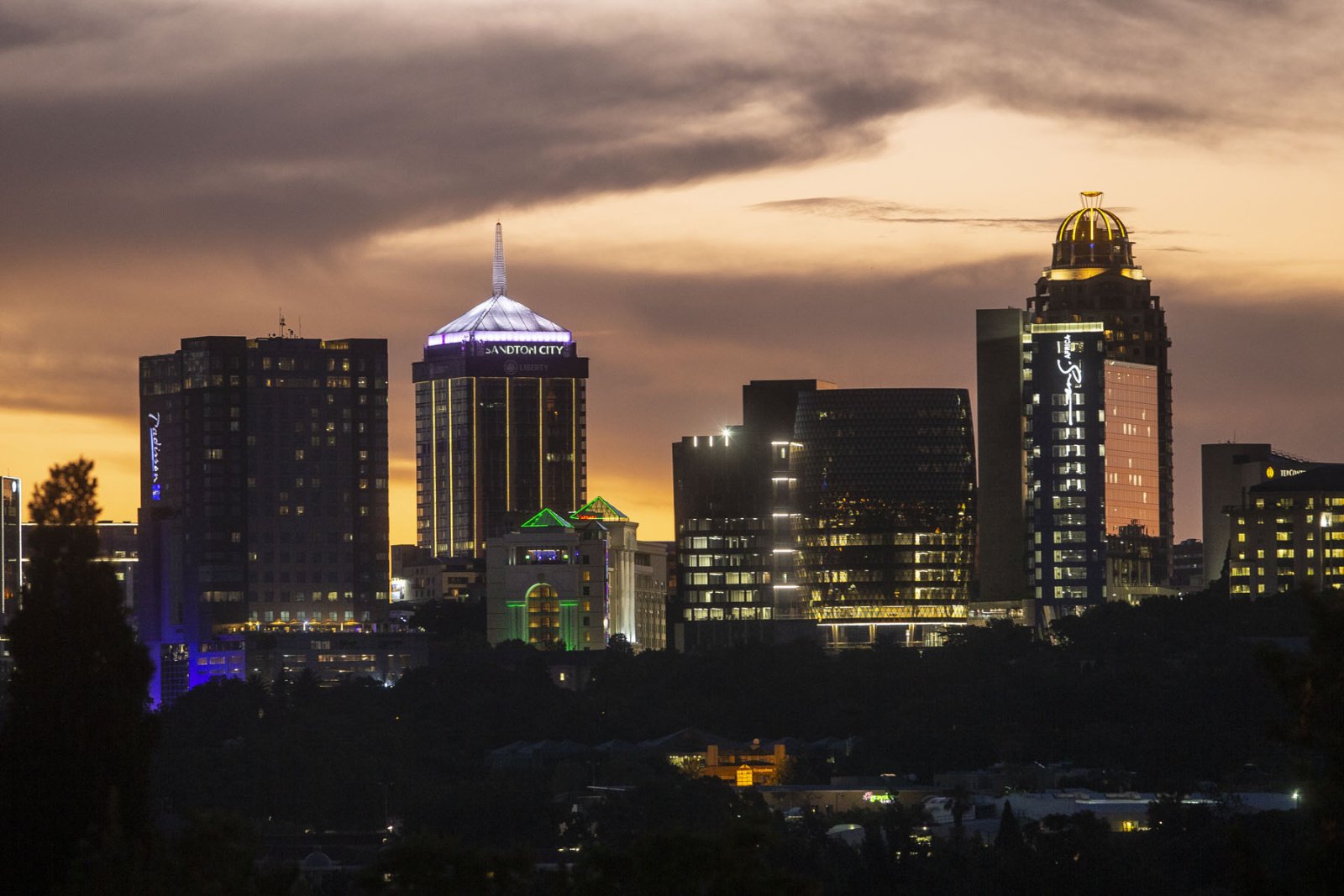
Sandton
Business towers, upscale malls, Nelson Mandela Square, and city nightlife.
Johannesburg CBD
Downtown streets, Commissioner Street, Gandhi Square, and real urban life.
Soweto
Township streets, Maponya Mall, Protea North, and cultural walking tours.
Rosebank & Melrose Arch
Shopping areas, nightlife, and modern mixed-use districts.
Johannesburg Latest News
IOL
Mosimane explains Foster snub as Bafana tenure begins
Pitso Mosimane says Lyle Foster’s lack of regular football influenced his decision to leave the striker out of Bafana Bafana’s upcoming qualifiers and friendly.
IOL
Shembe maidens face backlash over topless Reed Dance
Shembe Church members have questioned the participation of young female church members in the Reed Dance in Phongolo, with some arguing that going topless on the Sabbath conflicts with church rules. The eBuhleni faction says the Reed Dance is open to everyone and distinguishes between church rules and members' private lives.
The Citizen
Rassie struggles to read Wallabies
Rassie Erasmus says the Springboks find the Wallabies “tremendously difficult to play against” as they prepare for Sunday’s one-off Test in Perth. The Boks were given a painful reminder of Australia’s threat at Ellis Park last year, when they raced into a 22-0 lead before conceding 38 unanswered points to lose 38-22 – the Wallabies’ first victory at the Johannesburg venue since 1963. “And it was at altitude, and they only flew in that week,” Erasmus told the Sydney Morning Herald. “There was a little bit of arrogance from our side, being 22 up, and thinking, ‘It’s easy, boys, now’. I wouldn’t say it was disrespect, but I would say, stupidly, we thought, ‘OK, now we just can play this bloody loose game against Australia’. “And they held it, and [Max] Jorgensen and those guys cut us to pieces. They could have even given us more points in that game. They smashed us.” The Boks responded with a 30-22 victory in Cape Town a week later, but Erasmus says they have never taken success against the Wallabies for granted. ‘Difficult to play against’ “We find them tremendously difficult to play against, I don’t know why,” he said. “You just can’t say Australia play a certain way. That’s what’s tough for me, too, to analyse about them. “We have immense respect for the Wallabies. You look at the track record, we struggle. We never think, ‘Oh, we have Australia’s measure’, no. That’s not in our minds.” Erasmus has also been impressed by the Wallabies under coach Les Kiss, whose first four Tests in charge produced two wins against Japan and a win and a draw against Argentina. Erasmus first encountered Kiss when the Australian worked with the Boks in 2001, the final year of Erasmus’ Test career as a player. “He brought the first defensive structures,” Erasmus said. “Of course we didn’t have defensive structures in those days, it was all about just attacking. “I know Les, we’re good friends, I know him from his Ulster days [when Erasmus coached Munster], so I know him well.” This story was first published on sarugbymag.co.za. It is republished here with permission.
The Citizen
Swift helps Suzuki buck slowdown in Mzansi’s used-car market
Having established itself as South Africa’s second best-selling new car brand behind Toyota, Suzuki is also making waves in the pre-owned market. The Japanese carmaker in August stood out as the only top-10 brand to record year-on-year sales growth as overall activity declined. A total of 2 426 used Suzukis were sold through AutoTrader from 1 to 31 August. This is 8.3% more than the 2 240 units recorded in August 2025, despite sales easing slightly from the 2 461 vehicles sold in July. The brand’s performance was notable given the direction of the broader market. Total used-car sales through AutoTrader declined by 3.1% year-on-year in going from 34 402 units in August 2025 to 33 346 last month. Sales were also 4.1% lower than the 34 759 vehicles recorded in July. Not one of the other brands in the top 10 managed annual growth. Similar to the new car market, Toyota remained the market leader with 5 750 sales but slipped -0.5% year-on-year. Volkswagen declined by 10.1% to 4 287 and Ford fell 4.4% to 3 460. Suzuki Swift shines Similar to new sales, the Suzuki Swift was key to the brand’s pre-owned performance. With 874 sales in August, it was the fifth-best-selling used model overall and one of only five models to record more than 800 sales during the month. Suzuki Swift sales increased by 7.5% from the 813 units recorded in August 2025, although they were marginally lower than July’s 883 units. The hatchback was fifth behind the Ford Ranger, Toyota Hilux, Volkswagen Polo Vivo and Volkswagen Polo. The average used Suzuki Swift sold for R205 810. The typical Swift sold during August was a 2023 model with 33 821km on the odometer. Average mileage was around 11% lower than the 38 027km recorded for Swift models sold during August 2025, while the average model year moved from 2022 to 2023. Suzuki still trails the three largest used brands, Toyota (5 750), VW (4 287) and Ford (3 460). But the carmaker did manage to outmuscle Hyundai by 309 units, a rival they trailed by 147 in August 2025.
The South African
Meet the SASSA employees earning more than R2 million a year
The South African Social Security Agency (SASSA) spends R3.7 billion on salaries. On average, the agency’s employees earn R473 703 a year (R39 475 a month). But a handful of employees make more than R2 million a year. SASSA Employee Salaries SASSA employees are some of the richest in the country. According to the South African Revenue Service (SARS) data, the agency’s employees earn more than most. If the agency were a municipality, it would perform in the top 5. The agency’s average income is higher than the average income in the City of Cape Town, Stellenbosch, and Tshwane. Unskilled workers, typically those with a school-leaving certificate, earn R106 124 a year (R8 843 a month). Workers with matric or a diploma and without much experience earn R358 947 a year (R29 912 a month). Those with matric, diploma, a degree and work experience earn R557 944 a year (R46 495 a month). The average salary for lower management is R1 million a year. However, nine executives, including SASSA’s chief executive officer, earn more than R2 million a year. SASSA Employees Earning R2 Million a Year There are nine employees in the Head Office Executive team. According to the agency’s annual report, these employees have an average income of R2 198 847. Dr Paseka Cornelius Letsatsi (PhD) Letsatsi is SASSA’s Head of Communications. He got his PhD from the Da Vinci Institute in Lethabong. In 2014, Letsatsi was embroiled in a corruption scandal over improperly funded projects, which led the National Prosecuting Authority to seize his property. He has since been reinstated in the role. Mr Tsakeriwa Chauke SASSA’s Chief Financial Officer, Chauke has been in the role since 2016. Before becoming the CFO, he was the agency’s general manager of finance. Chauke is also a pastor. He routinely preaches about wealth creation. Mr Jabulani Makondo Makondo is SASSA’s Acting Chief Information Officer. Before being appointed to executive level, Makondo was a general manager, a position he has held since 2007. Ms Zodwa Mvulane Mvulane holds an LLB from the University of the North West. SASSA appointed Mvulane as executive manager of corporate services in 2025. But she’s held an executive role at SASSA since 2010. Before that, she worked at Invest North West as a trade and investment manager. Mr Brenton Van Vrede Van Vrede is the Executive Manager of Grants Administration. In this role, he has backed the use of technology to verify beneficiary details. He briefly served as the agency’s acting CEO before Themba Matlou got the job. Ms Raphaahle Ramokgopa Ramokgopa has served as SASSA’s Executive Manager of Strategy and Business Development since 2012. For a few months, she stepped away from this role to be the acting CEO of the National Development Agency.
The South African
Why Kaizer Chiefs have had a goalkeeping problem for over six years
Kaizer Chiefs have not enjoyed genuine stability in the goalkeeping department for more than six years. Since the decline and eventual retirement of club legend Itumeleng Khune, Amakhosi have struggled to find a goalkeeper capable of establishing himself as a long-term No.1. Even before Khune officially left the club, his position as first choice had already been lost. Daniel Akpeyi was brought in and given an opportunity, but his time as the club’s No.1 was far from convincing. Brandon Petersen and Bruce Bvuma were subsequently given opportunities, but neither managed to completely convince. Errors and inconsistent performances meant Chiefs continued to rotate their options between the sticks. The arrival of Fiacre Ntwari in 2024 appeared to offer a possible solution. The Rwanda international was seen as a positive signing, but his stay as first choice lasted just seven matches before costly mistakes saw him drop to the bench. Kaizer Chiefs keeps reschuffling keepers Bvuma was then trusted again late in 2024, but Amakhosi still could not find the consistency they needed. His inability to regularly keep clean sheets eventually opened the door for Petersen once more. Petersen appeared to finally be the answer. After an impressive performance in the 2025 Nedbank Cup final, he was handed the captaincy and established himself as Kaizer Chiefs’ first-choice goalkeeper. His 2025/26 campaign strengthened that argument, with Petersen earning a nomination for Goalkeeper of the Season and coming close to making Bafana Bafana’s World Cup squad. Petersen returns to his old ways, Kaizer Chiefs suffer Petersen has looked vulnerable at times and has already made four errors leading directly to goals. An injury has now forced Chiefs into another change, with Renaldo Leaner taking over in goal. And that brings Chiefs back to the same question they have faced repeatedly over the past six years: when will they finally find a goalkeeper they can trust for more than one or two seasons? The problem is not necessarily a lack of talent. Amakhosi have had experienced goalkeepers, promising youngsters and international-calibre options. The bigger issue appears to be the constant changing. The goalkeeper changes have often coincided with changes in the defence in front of them. Just as a goalkeeper begins to establish himself, an error, loss of form or injury can lead to another change. The backline can also be reshuffled, meaning the goalkeeper is constantly having to build new relationships with his defenders. That lack of continuity can be costly. For a club of Kaizer Chiefs’ stature, six years is a long time to still be searching for a long-term No.1. Petersen had appeared to break that cycle. His form last season suggested Amakhosi may finally have found someone capable of holding the position for the long term. This season, however, has raised the same old questions. With Petersen now injured and Leaner stepping in, Kaizer Chiefs face yet another goalkeeping transition. Will Leaner be the answer?
TechCentral
Hollard client data dumped on the dark web
The ransomware group behind the MIP Holdings breach now appears to be extorting insurers directly.
TechCentral
Vumatel operating profit jumps 57% as the Vodacom deal lands
Remgro’s results give the fullest look at Maziv’s performance with Vodacom’s fibre infrastructure inside it.