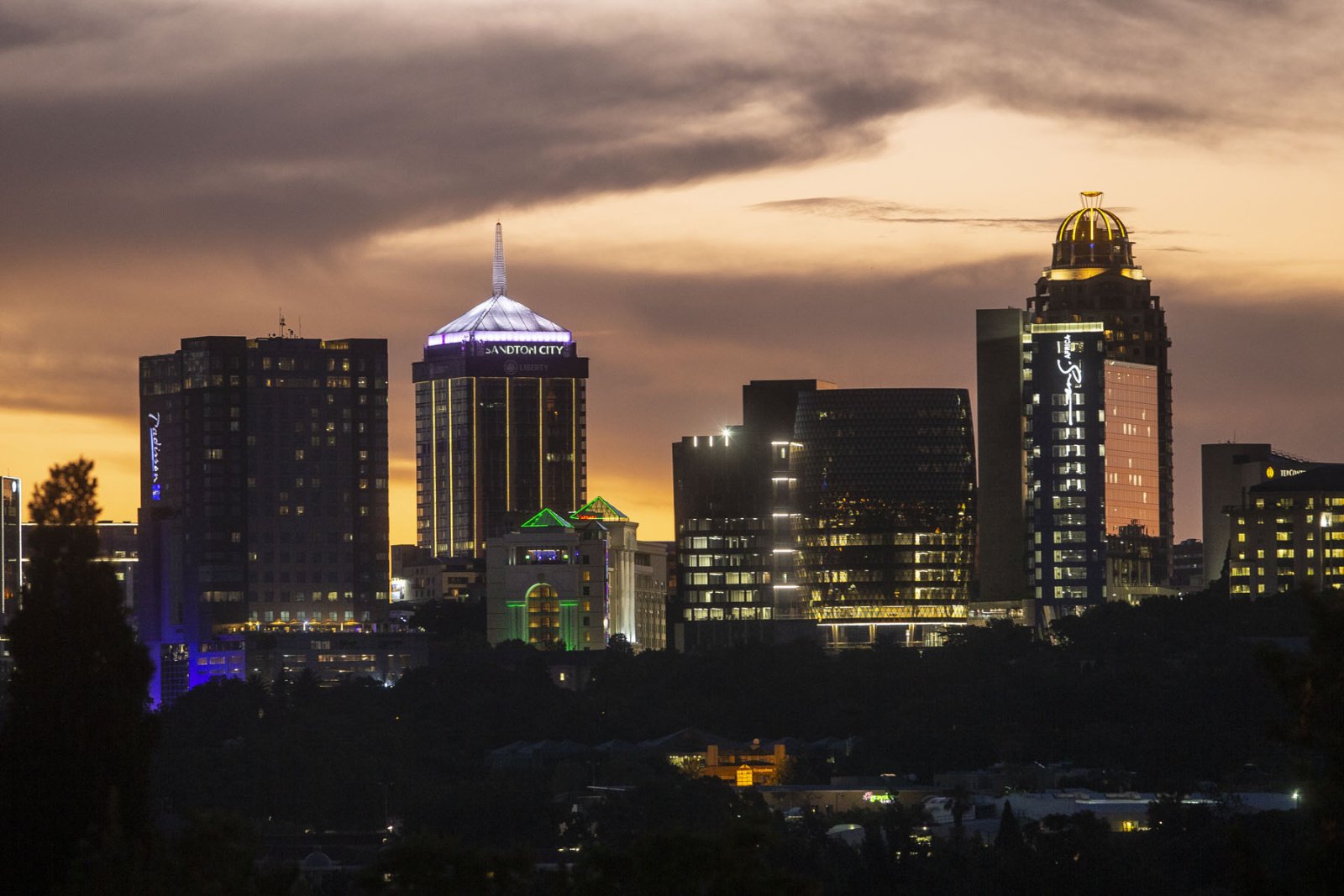
General Information
Johannesburg is the most populous city in South Africa. The City of Johannesburg itself has a population of 5,538,596, while the City of Johannesburg Metropolitan Municipality has a population of 6,599,190, making it one of the 100 largest urban areas in the world. Johannesburg is the provincial capital of Gauteng, the wealthiest province in South Africa, and seat of the country's highest court, the Constitutional Court. Situated on the mineral-rich Witwatersrand hills, the city has long been at the epicentre of the international mineral and gold trade. The richest city in Africa by GDP and private wealth, Johannesburg functions as the economic capital of South Africa and is home to the continent's largest stock exchange, the Johannesburg Stock Exchange.
- Population: 5,900,000+ (Metro Area)
- Area: 1,645 km²
- Currency: South African Rand (ZAR)
- Coordinates: Latitude: -26.204444885254, Longitude: 28.045555114746
- Timezone: Timezone info not available
- Current Local Time: ailab
Johannesburg Latest News
IOL
UK king braces as memoir by Diana's brother goes on sale
" Swan Song: Diana, My Sister", a memoir written by Diana's younger brother, has been published by Penguin and translated into 12 languages.
IOL
Cachalia outlines four-phase security plan for 2026 local elections
Acting Police Minister Firoz Cachalia says voter safety, election infrastructure and political violence will be addressed through a four-phase plan coordinated by Natjoints.
The Citizen
WARNING: More bad news about petrol prices in SA – Here’s how much you might pay in October
South African motorists face a brutal October as petrol and diesel prices threaten to smash records despite a recent dip in global oil. Latest figures from the Central Energy Fund (CEF) show 95 unleaded petrol could surge by nearly R2.80 a litre, pushing pump prices to around R29, eclipsing the June peak of R28.06. Diesel is set for an even harsher blow, with hikes of almost R3 likely to drive wholesale prices beyond R33 a litre, well above the May record of R31.88. Latest figures With the latest CEF figures showing recoveries deep in the red, motorists have no sign of relief. Petrol is already under‑recovering by R2.62 (93 octane) and R2.78 (95 octane) per litre. Diesel is worse, with deficits of R2.63 (0.05% sulphur) and R3.00 PER litre (0.005% sulphur). If current conditions hold, petrol could rocket to R29.70 per litre, eclipsing the June 2026 record of R28.06 set during the Iran War shock. Diesel is heading for its own disaster. With wholesale prices at R30.05 per litre, October could push levels to R33.05 per litre – smashing the May 2026 peak of R31.88. Forecast If these projections hold, motorists could pay the following in October 2026: Petrol 93: increase of R2.62 per litre Petrol 95: increase of R2.78 per litre Diesel 0.05% (wholesale): increase of R2.63 per litre Diesel 0.005% (wholesale): increase of R3.00 per litre Illuminating paraffin: increase of R3.13 per litre Global conflict Global conflict remains the fuel behind this crisis. Russia’s war in Ukraine has intensified, with drone strikes on energy infrastructure disrupting exports. Analysts warn restrictions on Russian diesel shipments could tighten supply further, driving costs higher worldwide. The ripple effects are clear: higher transport costs, squeezed disposable incomes, and mounting inflationary pressure. Warning Economists caution that households and businesses alike will feel the strain, with rising interest rates compounding the pain. South Africa’s economy, already under pressure, now faces another wave of fuel‑driven inflation. For motorists, October could mark the most punishing month yet at the pumps. Global oil markets are entering a “new normal” of recurring price shocks, with Brent crude expected to fluctuate between $65 and $95 per barrel. Economists warn this volatility will weigh on growth, inflation, and household budgets, particularly in South Africa, where GDP is forecast at just 1.2%. Rising fuel costs, climate shocks, and inequality are intensifying pressure, but adaptation – from hybrid vehicles to rail transport – may open new opportunities as nations adjust to sustained energy uncertainty.
The Citizen
‘I’m back’: Tatjana Smith targets 50m sprint at 2028 Olympic Games
Four-time Olympic medallist Tatjana Smith has set her sights on a return to the multi-sport Games as she prepares to make her comeback to competitive swimming this week. Smith, who retired after the 2024 Olympics in Paris, had entered the SA Short Course Championships in Pietermaritzburg starting on Thursday where she was expected to turn out in the 50m, 100m and 200m breaststroke events. However, the 29-year-old breaststroke specialist said her main focus over the next couple of years would not be the 100m or 200m events in which she had earned four Olympic medals between 2021 and 2024. Instead, with the 50m breaststroke being introduced to the programme for the first time at the 2028 Games in Los Angeles, she was concentrating on the sprint distance. “The 50m is different. One length, no turn, no room to settle. Almost no time to recover if the start, pull-out, breakout or touch goes wrong. Everything happens now, and it scares me but it also excites me,” Smith said in a social media post. Writing new history Having achieved two gold and two silver medals at previous editions of the Olympics, Smith was already South Africa’s most decorated Olympian (while fellow swimmer Chad le Clos also had four career medals, his bag included one gold and three silver). And if she could return to the podium in Los Angeles, Smith would become the first SA athlete in any sport to secure five podium places at the prestigious quadrennial showpiece. “I’m choosing a new event that has no history but I’ll try and write new history,” said the former 200m world record holder. But she insisted she was not getting ahead of herself, admitting she had a lot of work ahead of her to put herself in contention against younger opponents. “LA 2028 is the goal. It is not a promise. I still have to build a race, qualify and earn my spot back on those blocks,” said Smith, who had moved from Pretoria to Stellenbosch and was working with a new coach. “I don’t know how the story ends but I know I want to find out. The work starts here… I don’t know, how do I say it? I’m back.”
The South African
‘Not sick for golf’: Layla Kolbe calls out Ramaphosa over GBV
Layla Kolbe, the wife of Springbok Cheslin Kolbe, called out President Cyril Ramaphosa after he addressed the “national crisis” of Gender-Based Violence in South Africa. This follows the death of 10 women in the last two months. PRESIDENT CYRIL RAMAPHOSA ATTENDS GOLF DAY, ADDRESSESS GBV President of South Africa, Cyril Ramaphoa, promised a stronger government response to gender-based violence (GBV) as police continue to investigate the murders of 10 women in Gauteng in the last two months. The President had been booked off sick from 16 September, while the public was calling for a response and action following the murder of multiple women in Ekurhuleni in Gauteng. So, when Ramaphosa attended the ANC Veterans League fundraising golf day at the Johannesburg Country Club in Woodmead on Monday, many were upset. At the event, the president spoke to journalists, responding to the murders of women and GBV in the country. The president said women should not have to live in fear of being abused or killed, and that the problem does not affect women alone. He described it as “a national crisis” that must be treated as one. Ramaphosa said government will commit more money, resources and technology to tackle the fear women face. “Gender-based violence is not only a problem for women, but it’s also a national crisis, and we need to be treating it with exactly that. And we’re going to even be deploying more money, more resources, more technology to ensure that we deal with the fear that women are now subjected to,” he said. LAYLA KOLBE CALLS OUT PRESIDENT RAMAPHOSA Springbok WAG Layla Kolbe took to her Instagram Stories to call out Ramaphosa, and continued the fight against GBV in the country, as women live in fear everyday. She shared a screenshot of Ramaphosa attending the golf day writing: “your ANC president is not sick for golf today.” She went on to question why allocating resources had not already been prioritised. Layla went on to say that the death penalty is the only answer. “Every time its like we starting from scratch? Why have you not been prioritising this all along? We marched years ago and you promised the same! Now its just more this and more money and more money! Death penalty is the only answer, sorry to say,” she wrote. Layla Kolbe calls out President Ramaphosa. Images via Instagram @laylakolbe. Layla then took to her stories to state that the President only spoke because he attended the golf day. “Also, he’s now soema better to speak today because its his golf day! His staff told him to say something before showing up for golf. Mxm. Its not about the ANC anymore people! They dont give a damn about your loyalty! They safe with their many bodyguards and lavish lives while they hand out blankets for loyalty! Come on! South Africa deserves better,” she wrote. “So how’s government going to act? After women are dead? Why arent you acting for all the years in power??????? We need change! We need action! We needed protection from Day 1,” she continued. She went on to say that we need better law enforcement in the country. “He says even if GBV happens in the privacy of peoples homes. No cupcake, she went for a run!!!!! She went to the post-office! We dont expect you to protect us in the privacy of our homes. We expect better law enforcement 😩😔 yoh. Dont say plain and simple. You are doing nothing yet you say its ‘plain and simple’. You know what is plain and simple? Better and stricter laws. Death penalty. Plain and simple!!!!!!!,” she wrote. This comes after former Top Billing presenter Janez Vermeiren also called President Cyril Ramaphosa over the GBV crisis in South Africa.
The South African
HOW one man collects SASSA grants while earning R1 million, tax free
No one begrudges recipients of South African Social Security Agency (SASSA) Grants earning a little extra on the side. One man, let’s call him “Joe” for the purposes of the story, runs an off-the-books township butchery. It’s pretty simple, he buys meat in bulk and sells it in smaller portions in his township. According to KasiNomics Unleashed, a book written by GG Alcock, this earns Joe around R70 000 a month. Ever the entrepreneur, Joe also rents out backrooms on his property, earning himself another R10 000. On top of all that, because Joe is a pensioner, the household also cashes in on Older Person SASSA Grants each month. SASSA GRANTS, PLUS R1 MILLION A YEAR Add up the SASSA grants and Joe’s free-market efforts and he brings in R86 500 a month, or R1 million annually. Crucial to it all: “He has no paperwork. His business pays no rent, no utilities. He sees no need to formalise his businesses,” explains Alcock. Better still, Joe received an RDP house from government back 2002. He later built six rental units on the same plot, each bringing in R750 to R1 500 a month, largely from foreign nationals. However, government is no longer blind to this drain of public coffers. Finance Minister Enoch Godongwana has flagged the informal economy, along with the taxi industry, as priority areas for tax revenue. As such, SARS is rolling out an Informal Economy Response Strategy (IERS) aimed at retailers and micro-enterprises. Since 2024, it’s already pulled 21 890 previously unregistered taxpayers. In turn, this has generated R314 million in additional revenue, says Godongwana. HOW DOES HE BEAT THE SASSA GRANTS MEANS TEST? What’s an acceptable level of additional income over and above SASSA Grants? Image: File This flagrant disregard for SASSA grants due process is a separate, thornier question. Is the SASSA means test for the Older Person Grant thorough enough if it’s missing undocumented cash flow of people like Joe? If his real household income was verified, he would not qualify at all. And Joe is one of possibly millions of examples of a larger invisible pattern. So, we’d genuinely like to know where our readers land on this. Is Joe simply a smart operator working the system? Or is he exactly the reason strict and divisive agency measures are being put in place to throttle back social welfare, ultimately harming those who really need it? But what do you think? We’d love to hear your interpretation. Please share your thoughts in the comments section below …
TechCentral
Bank Zero breaks even as Mukuru migration swells its base
Bank Zero broke even in August, then took half a million end customers from remittance group Mukuru.
TechCentral
AMD is now worth a trillion dollars
AMD touched a $1-trillion valuation for the first time as investors bet AI spending is still expanding.