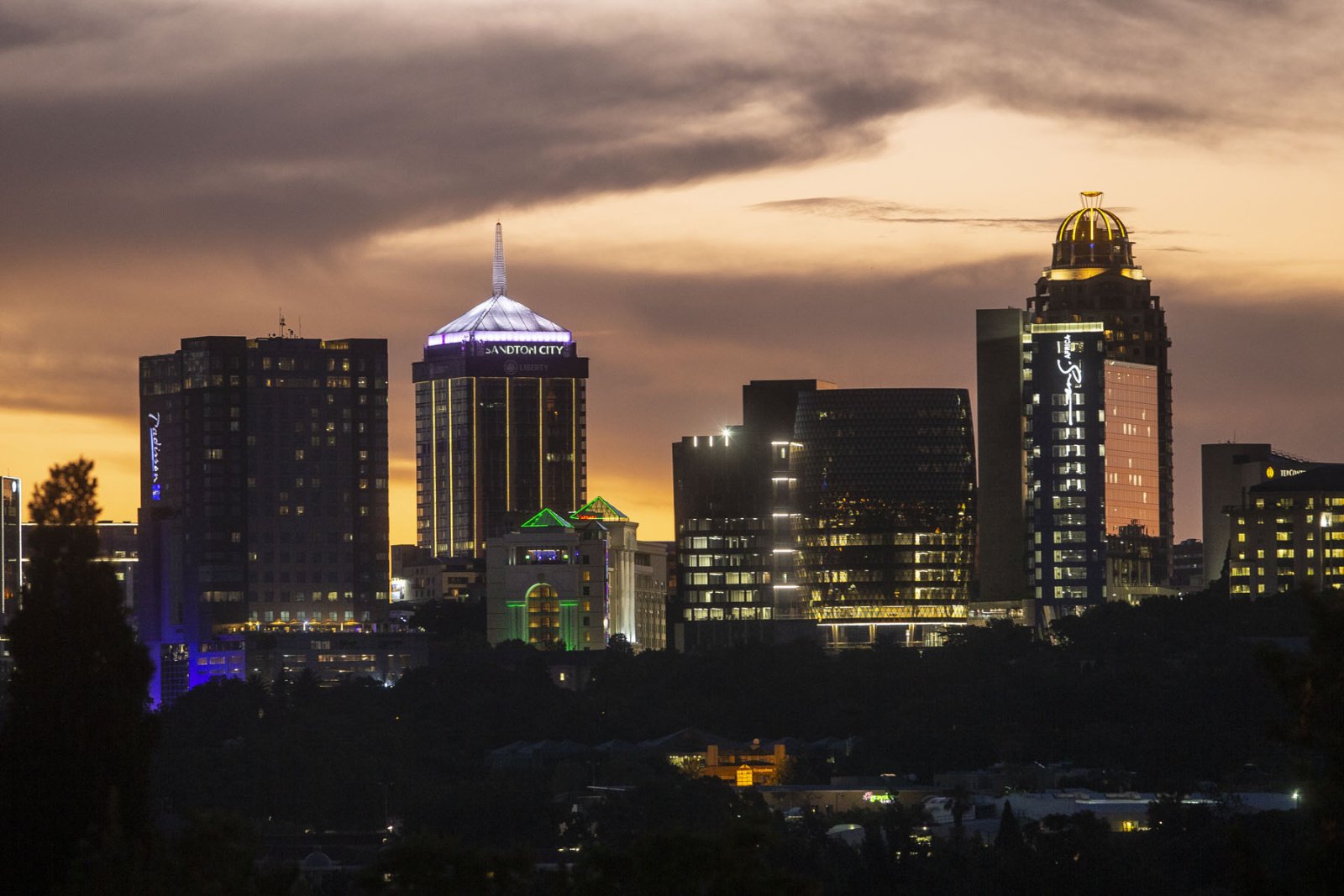
General Information
Johannesburg is the most populous city in South Africa. The City of Johannesburg itself has a population of 5,538,596, while the City of Johannesburg Metropolitan Municipality has a population of 6,599,190, making it one of the 100 largest urban areas in the world. Johannesburg is the provincial capital of Gauteng, the wealthiest province in South Africa, and seat of the country's highest court, the Constitutional Court. Situated on the mineral-rich Witwatersrand hills, the city has long been at the epicentre of the international mineral and gold trade. The richest city in Africa by GDP and private wealth, Johannesburg functions as the economic capital of South Africa and is home to the continent's largest stock exchange, the Johannesburg Stock Exchange.
- Population: 5,900,000+ (Metro Area)
- Area: 1,645 km²
- Currency: South African Rand (ZAR)
- Coordinates: Latitude: -26.204444885254, Longitude: 28.045555114746
- Timezone: Timezone info not available
- Current Local Time: ailab
Johannesburg Latest News
IOL
US AI data centre gas outage forces Virginia residents to evacuate over air quality concerns
A power failure at a Virginia data centre forced the facility onto backup generators for 24 hours, sending thick smoke into the air and driving nearby residents from their homes.
IOL
Kaizer Chiefs fall further behind Mamelodi Sundowns after home draw with Stellenbosch
Kaizer Chiefs settled for a 1–1 draw against Stellenbosch, falling further behind log leaders Mamelodi Sundowns despite Mduduzi Shabalala cancelling out Sinoxolo Kwayiba’s second-half strike.
The Citizen
Tshwane reduces water tanker budget by 79%
Gauteng premier Panyaza Lesufi, has hit back at the DA, saying it was crying at the wrong funeral after DA Tshwane mayoral candidate Cilliers Brink announced he would be challenging the premier at his office this week over a lack of action on what he described as Tshwane’s water tanker mafia. This is hot on the heels of City of Tshwane mayor Nasiphi Moya’s end-of-term report, reflecting on the progress made under her leadership over the past two years on Monday. Tshwane reduced tanker budget to R126.7 million During the briefing, deputy mayor and MMC for finance Eugene Modise said that from 1 April, 2026, the city began transitioning formal areas towards a municipal-led tanker service and expanded the city’s municipal tanker fleet to 41 vehicles. “At peak, tanker operations were costing R20.56 million per month. Through tighter management and reduced reliance on outsourced services, this was brought down to R8.34 million per month. “For 2026-27, the tanker budget has been reduced to R126.7 million, a 79% reduction, while R110 million has been redirected towards municipal tankers, pipe replacement and infrastructure upgrades,” said Modise. For four consecutive years, Tshwane had operated with unfunded budgets, but the 2025-26 budget was fully funded as was the 2026-27 budget. “The city owed Eskom R6.66 billion, carried a broader debt burden of more than R13 billion and had only R835 million in cash reserves,” said Modise. Report highlights fully funded budgets, debt burden reduction and audit qualification “In 2023-24, R322.95 million in tanker expenditure had been incurred, including R179.9 million in unpaid invoices that were carried forward. “Between July and mid-October 2024, before we took office, a further R98 million was incurred. By September 2024, the tanker budget had already been exhausted, and an additional R150 million had been requested.” Moya said: “In the 2024-25 financial year, the number of audit qualification areas declined from six to just two.” Other successes included the repair of 21 285 streetlights and high-mast lights restored. MMC for environment and agriculture Obakeng Ramabodu said since October 2025, more than 19 000 tons of illegally dumped waste have been removed across Tshwane. TMPD conducted crime prevention, bylaw and illegal dumping operations MMC for community safety Hannes Coetzee said between July 2025 and June 2026, the Tshwane Metro Police Department (TMPD) conducted 817 regional and 909 specialised crime-prevention operations, alongside 140 illegal cable-theft operations. “TMPD also undertook 402 regional bylaw operations, 213 specialised bylaw operations and 236 illegal dumping operations. During 2025-26, officers made 1 748 arrests for driving under the influence. “Two mobile alcohol evidence centres were introduced, following the qualification of 10 mobile alcohol evidence operators in November 2024. “Officers identified 35 397 vehicles without displayed licence discs, 8 508 without number plates and 29 345 without licences. Seven stolen vehicles were recovered through impounding and another 25 through enforcement,” he added.
The Citizen
Overhang risk could distort council balance after elections
South Africa’s municipal electoral system could face a constitutional challenge after next month’s local government elections if political parties win substantially more ward seats than their overall share of the vote justifies. The proportional representation (PR) system designed to balance ward victories may then run out of seats to correct the discrepancy. This may leave councils not adequately reflecting how residents voted. Growing political fragmentation could make such an outcome more plausible, with consequences for coalition governments. System designed to balance ward victories may run out of seats While the Electoral Commission of South Africa (IEC) maintains existing legislation is adequate, ActionSA has indicated it could consider a constitutional challenge. Political analyst Theo Neethling said the problem, known as electoral overhang, was not unique to South Africa. Other countries had introduced compensatory seats or expanded legislative bodies to correct imbalances. South Africa faces difficulties because legitimately elected ward councillors could not simply be removed. “The problem could become particularly apparent during the 2026 elections as multiparty politics and vote fragmentation increase,” said Neethling. A party does not need an outright majority to win a ward, only more votes than any other candidate. It could therefore win with 30% support while opponents divide the remaining 70%. Party could win ward with 30% support while opponents divide remaining 70% Repeated across enough wards, this could give a party substantially more council seats than its overall vote justifies. IEC spokesperson Kate Bapela acknowledged the theoretical possibility, but said safeguards limited the extent of overhang. “Councils are always 50% ward seats and 50% PR seats. That means no party can win more than half the council through wards alone,” she said. Parties winning more wards than their proportional entitlement would receive no additional PR seats. A Johannesburg DA ward councillor warned that parties placing mayoral candidates solely on PR lists could face another complication. Should an overhang leave their party without PR seats, the mayoral candidate might not return as a councillor, ending any prospect of becoming mayor. Ekurhuleni provides a hypothetical example. Its 224-member council has 112 ward and 112 PR seats. A party receiving 25% of the relevant vote would ordinarily qualify for about 56 seats. Ekurhuleni council example However, winning 78 wards would give it almost 35% of council, creating a 22-seat overhang. The remaining parties, collectively attracting 75% of the vote, would occupy only around 65% of council if its size remained unchanged. ActionSA’s Michael Basch said the consequences could extend beyond representation. “If one party ends up with 35% of the seats on 25% of the vote, 10 percentage points of council power have been taken from the parties voters actually chose. In a hung council, that difference decides who forms the coalition, who becomes mayor and who controls the budget,” he said. Although such an outcome would require a party to win about 70% of wards on a quarter of the vote, Basch said fragmented opposition support made it possible. Neethling cautioned that a discrepancy would not automatically constitute a constitutional crisis, although a sufficiently severe imbalance could invite litigation. “The irony is that greater political competition and a proliferation of parties – normally viewed as strengthening democracy – can actually lead to greater disproportionality,” he said. Johannesburg faces complications because 270-member council already at statutory maximum Johannesburg faces an additional complication because its 270-member council is already at the statutory maximum for a metropolitan municipality. Bapela said the IEC could not simply expand PR representation to correct an overhang. “Even if overhang occurs, the IEC cannot expand PR seats alone, it must expand ward seats equally, which would defeat the balancing purpose,” she said. Nevertheless, the commission maintained that existing legislation was adequate. “Overhangs are contained by the 50% ward cap, so they cannot distort councils beyond that threshold.” Basch argued that Schedule 1 of the Act allowed parties to retain excess ward seats without adequately compensating other parties. Directly elected ward had to be protected “Many other mixed systems add ‘balance seats’ for exactly this situation. Ours does not,” he said. DA Ekurhuleni mayoral candidate Khathutshelo Rasilingwane said directly elected ward councillors had to be protected without undermining proportional representation. “Ward representation is important because it gives communities a directly accountable councillor, but ward victories should not result in a council composition that is fundamentally disconnected from the overall vote,” she said. Rasilingwane said the DA would support reviewing the legislation if it proved inadequate, provided changes applied equally to all parties rather than benefiting particular electoral outcomes. ActionSA also supported a review, though Basch said changing the rules before the 4 November elections would undermine electoral certainty. He called for a review early in the next municipal term and said ActionSA would seek legal advice if a disproportionate result affected who governed.
The South African
‘Betray his whole family’: Angelique Gerber shades Jacques Potgieter?
Angelique Gerber has shared a cryptic post alluding to her ex, Jacques Potgieter. This comes after the actress and the former Springbok fuelled rumours that they had reconciled following a four-year separation. During that time, Jacques dated another woman, whom he split from in June. Jacques and Angelique married in 2016 and have three children together: son Jacques Jnr and twin daughters Annabella and Olivia. ANGELIQUE GERBER THROWS SHADE AT EX, JACQUES POTGIETER? On her Instagram Stories, Angelique posted several cryptic quotes about “exes”. One read: “Your ex is running someone else’s life. You are safe”. Another stated: “If you ever feel stupid….just remember a woman saw a man betray his whole family and still thought, ‘that’s my soulmate” Angelique Gerber’s IG Stories. The former 7de Laan actress appeared to be shading her ex, Jacqus Potgieter, and implying that he had moved on to another relationship. It comes as Jacques has deleted pictures of himself and Angelique, which followers believed alluded to their short-lived reconciliation. In several since-deleted posts, the former couple are seen embracing each other. In one pic, Jacques carried Angelique in the air, whilst in a third, she sat on his lap. “I hit the bullseye”, he captioned the post. Referring to his ex, he posted in another: “You make my heart beat fast again”. Jacques Potgieter deleted pictures of him with his ex.Images via IG WHAT WENT WRONG? Jacques Potgieter and Angelique Gerber wed a decade ago on a wine farm in the Western Cape. The couple began dating in 2014, when Angelique played the popular character “Clara” on the now-defunct SABC soapie 7de Laan. In mid 2022, Jacques allegedly admitted to being unfaithful to his Springbok wife, Angelique Gerber in a series of Instagram Stories. At the same time, Angeliqe posted a cryptic post on her IG Stories that read: “The truth always comes out”. Jacques later claimed his account was “hacked” and assured the public the accusations about his marriage and alleged affairs were false. Angelique then posted an apology on her account, implying the same. By Christmas, it was clear the couple had officially split after removing all romantic posts featuring each other. To further fuel the fire, Jacques began posting pictures with his new girlfriend, Lizane Wagner. Fast forward to 2023, and Angelique put Jacques Potgieter on blast for failing to financially support their three children. In June, the retired rugby player – now a head coach for Centurion Rugby Club – split from Lizane. This followed a four-year relationship with the woman many have accused of being behind his marriage breakdown. Speaking to an Afrikaans publication, Lizane confirmed their break-up, adding that she was not the “other woman” in her ex’s marriage.
The South African
Pensioner feeding several dependants on one SASSA grant shares his biggest fear
A Mpumalanga pensioner says his biggest concern is not his own survival but his children’s future. The Older Person’s Grant recipient, who asked to remain anonymous, shared his story in The South African’s SASSA grant survey. He has received the grant for three years. Five people depend on that single grant at home, and he says it simply does not stretch far enough. Children’s future weighs on the pensioner When asked about his biggest financial concern, the pensioner pointed to his children’s future. That worry is rooted in a hard reality. Someone in his household has gone without food in the past month. He regularly struggles to make ends meet and runs out of money before the month ends. He spends his grant on a mix of essentials, from food to everyday household costs. With several people relying on one income, every rand is already accounted for long before the next payment arrives. Owning his home gives the family a roof over their heads, but it does not guarantee food on the table. Still searching for work The pensioner is unemployed and actively looking for work. He has experience in construction and general labour and says he is willing to relocate for the right opportunity. He believes a job would give his family the security the grant alone cannot provide. Long queues and waiting times at SASSA offices remain his biggest challenge with the grant system, although he says his payments have been straightforward. He rates SASSA’s communication with recipients as poor and has never applied for additional government support because he did not know what else was available. His call for a bigger grant The pensioner acknowledges that the grant helps his household. “The grants does help a little bit,” he said. However, he wants to see the amount rise. “If it can be increased it will be better,” he added. He suggested R5 000 a month would make a real difference for families like his. If he could change one thing about SASSA, he would increase the grant amount. For now, he continues to stretch one grant across an entire household while hoping for a better future for his children. Win R2 000 in the South African SASSA grant survey If you receive a SASSA grant and want to share your story, we want to hear from you. Take part in our survey and stand a chance to win R2 000. Your responses help us tell the stories that matter.
TechCentral
Icasa’s R100-million surplus and its empty toolbox
Icasa left R333.7-million unspent in 2025/2026 while telling parliament it lacks money for regulatory tools.
TechCentral
iOCO profit jumps 39% as operating cash flow falls 44%
iOCO's profit rose 39% to R357-million in FY2026, but net cash from operating activities fell 44%.