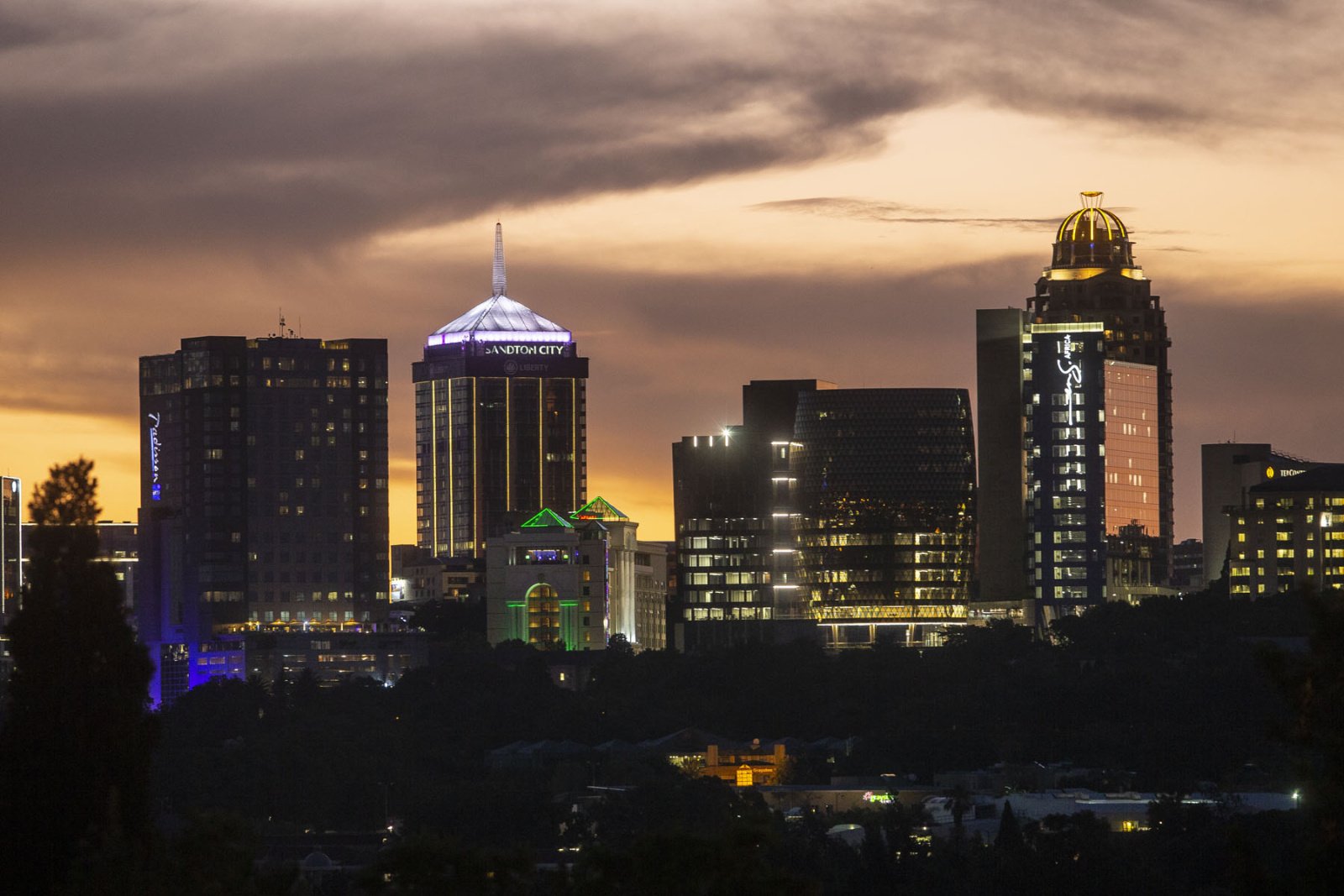
General Information
Johannesburg is the most populous city in South Africa. The City of Johannesburg itself has a population of 5,538,596, while the City of Johannesburg Metropolitan Municipality has a population of 6,599,190, making it one of the 100 largest urban areas in the world. Johannesburg is the provincial capital of Gauteng, the wealthiest province in South Africa, and seat of the country's highest court, the Constitutional Court. Situated on the mineral-rich Witwatersrand hills, the city has long been at the epicentre of the international mineral and gold trade. The richest city in Africa by GDP and private wealth, Johannesburg functions as the economic capital of South Africa and is home to the continent's largest stock exchange, the Johannesburg Stock Exchange.
- Population: 5,900,000+ (Metro Area)
- Area: 1,645 km²
- Currency: South African Rand (ZAR)
- Coordinates: Latitude: -26.204444885254, Longitude: 28.045555114746
- Timezone: Timezone info not available
- Current Local Time: ailab
Johannesburg Latest News
IOL
WATCH | What South Africa wants from Godongwana’s mini-budget speech
From relief at the petrol pumps to tighter spending controls and economic reform, Finance Minister Enoch Godongwana faces competing demands as he prepares to deliver today’s mini-budget.
IOL
Gauteng woman arrested over fake kidnapping and R40,000 ransom demand from cousin
Gauteng police have arrested a woman who allegedly staged her own kidnapping with one accomplice and demanded a R40,000 ransom from her cousin.
The Citizen
Want to join the police? Here’s how long the Saps recruitment window is open
The South African Police Service (Saps) is opening applications to join a law enforcement body that records more than 1 500 violent crimes every day. The national police force plans to bolster its numbers by 5 500 through a recruitment drive targeting South Africans aged 18 to 34. Applicants may not have a criminal record or any pending criminal cases, with Saps encouraging the patriotic and service-driven South Africans to apply. “Saps is looking for more than just a uniform. It is looking for young people who can bring knowledge, skills, fresh perspectives and a commitment to excellence to the fight against crime. “If you are disciplined, physically fit, committed to serving your community and determined to help build a safer South Africa, this could be your moment,” Saps’ recruitment drive post states. ‘Discipline and integrity’ Those who make it to the front lines may experience the hidden brutality of law enforcement. Saps’ crime statistics state a combined 296 379 murders, attempted murders, robberies, assaults and sexual offences were reported between January and June. For the unphased applicants, accepted trainees will receive a R5 000 monthly stipend for the duration of their training, with that being bumped up to roughly R250 000 per year once they become full members. Recruits with a higher qualification or an NQF Level 6 will undergo six months of training at the Saps training academy, while those with a matric will complete a nine-month course at the academy. Applications are free of charge and are completed online by creating a user account using an email address. Saps stressed that no positions are for sale and applicants must beware of potential fraudsters. The recruitment drive includes a specialised skills component, with qualified applicants able to progress to specialised units. Law, criminology, natural sciences, computer sciences, information technology, and other relevant graduates may be considered for placement within the Hawks, Crime Intelligence or forensic services. “Every applicant will undergo a rigorous selection process, including fitness, psychometric and integrity testing, a medical evaluation and an interview. “These assessments are designed to ensure that those selected possess the physical fitness, mental resilience, discipline and integrity required to serve and protect the people of South Africa,” Saps stated. Low interest from minorities Saps confirmed that applications were open to all racial groups, with underrepresented demographics encouraged to apply. The police ministry confirmed in a recent written parliamentary response that Saps had an employment equity target of 80.9% black, 8.8% coloured, 7.7% white and 2.4% Indian membership. The ministry said that last year’s trainee intake fell short of the targets, explaining it had difficulty attracting interest from coloured, indian and white applicants. Saps received 1.04 million applications during the 2025 application window, with 992 075 (94.4%) coming from black applicants. Indian applicants accounted for 0.29% of submissions, while coloured and white applicants accounted for 5.12% and 0.1% of submissions, respectively. The police ministry did not confirm the demographic breakdown of the 5 500 recruits eventually chosen for the 2025 training programme.
The Citizen
Road safety still a problem in Gauteng as 6 000 vehicles removed from roads in a week
Despite the Gauteng Traffic Police (GTP) conducting operations across the province, non-compliance of road users remains a major issue. During the operations conducted between 12 and 18 October 2026, more than 6 000 unroadworthy vehicles were recorded, with incidents including faulty brakes, defective rear lights and tyre problems. Traffic offences A total of 148 vehicles were taken off the roads and impounded. Traffic officers also charged 457 motorists for failing to produce professional driving permits and driving licences. More than 3 400 traffic offences were also recorded, including traffic light violations, speeding, failure to wear seatbelts, overloading and driving unlicensed vehicles. 15 arrested These operations also resulted in the arrest of 15 suspects while a total of 21 pedestrians were arrested for being a source of danger on freeways. In separate crime prevention operations, the GTP arrested four suspects in Daveyton for illegal electricity connections and the contravention of the Immigration Act. Another 15 suspects were arrested for drug dealing, possession of drugs and driving under the influence of alcohol. The GTP also recovered two vehicles in Daveyton and Boksburg.
The South African
Giraffes wander onto Skukuza Golf Club – WATCH
Golfers at Skukuza Golf Club received a wildlife surprise when two giraffes were spotted casually wandering across the fairways at the famous Kruger National Park course. The sighting was shared in a video on the club’s Facebook page, showing the two gentle giants enjoying a leisurely morning at one of South Africa’s most unusual golfing destinations. The club captioned the footage with a light-hearted message. “Well, look who popped in for an early morning visit! “These two beautiful giraffes were out enjoying a leisurely Sunday morning at Skukuza Golf Club. No rush, no tee times, just two gentle giants making themselves right at home on the course. “We wouldn’t have our mornings any other way!” The ‘wildest golf course in the world’ Situated inside the Kruger National Park, Skukuza Golf Club is often described as the “wildest golf course in the world”. Unlike conventional golf courses, where players mainly contend with bunkers, water hazards and challenging fairways, Skukuza offers the possibility of encountering wild animals roaming freely through the area. The course is unfenced, allowing wildlife to move through the grounds as part of the surrounding natural environment. Giraffes are among the many animals that have been spotted at the course, alongside elephants, buffalo, various antelope species and other wildlife. Predators and potentially dangerous animals, including lions, hippos and crocodiles, have also been reported in the area. For golfers, that means keeping an eye on more than just the ball. Have you ever played 18 holes at Skukuza Golf Club? Let us know by clicking on the comment banner below …
The South African
No visa, no Joburg stopover: 5 beach escapes you can fly to directly from Cape Town
Visa-free beach escapes have never been easier to reach from the Mother City. For years, a beach holiday north of the border meant one thing for Capetonians. A long detour through Johannesburg. Not anymore. In October, new direct flights from Cape Town to Zanzibar and Mauritius took off, adding to a growing list of beach destinations you can reach without changing planes. Better yet, South Africans don’t need a visa for any of them. Here are five to put on your list. ZANZIBAR, TANZANIA White sand, turquoise water and the narrow streets of historic Stone Town. The first direct flights between Cape Town and Zanzibar took off on 3 October. They fly once a week, on Saturdays, and take just over six hours. Visa rules: South Africans can visit Tanzania, including Zanzibar, without a visa for up to 90 days. Good to know: Zanzibar has required foreign visitors to buy mandatory travel insurance since 2024, and mainland Tanzania introduced its own requirement on 1 October 2026. Both cost $44 (about R724) per adult. Residents of Southern African Development Community (SADC) countries, including South Africa, are exempt from the mainland policy. Check the latest requirements for Zanzibar before you fly. MAURITIUS It’s South Africans’ favourite island getaway for a reason: calm lagoons, mountain views and plenty of options for every budget. Cape Town travellers can now choose from several direct flights to Mauritius, including new twice-weekly flights that launched on 2 October. The flight takes about five hours. Visa rules: South Africans can visit Mauritius visa-free for up to 90 days. VILANCULOS, MOZAMBIQUE Vilanculos is the gateway to the Bazaruto Archipelago, a protected marine park famous for its dunes, coral reefs and dhow trips. It’s also home to remarkable marine life. Scientists at Benguerra Island have reported regular orca sightings in recent months. Visa rules: South Africans can visit Mozambique without a visa for up to 30 days per visit. SWAKOPMUND, NAMIBIA Fly direct to Walvis Bay, then drive about half an hour to Swakopmund, a seaside town where the desert meets the Atlantic Ocean. It’s not a tropical beach, but it offers something unique: sandboarding on the dunes in the morning, and fresh oysters by the sea in the evening. Visa rules: South Africans can visit Namibia visa-free for up to 90 days a year. MAPUTO, MOZAMBIQUE Mozambique’s capital is a lively mix of colonial architecture, seafood markets and city beaches. It’s also a base for exploring further afield, including the island of Inhaca, a short boat ride across Maputo Bay. Visa rules: The same 30-day visa-free rule applies as in Vilanculos. TIPS FOR A BUDGET-FRIENDLY BEACH ESCAPE Book early, since direct routes have limited seats, especially over the December holidays. Avoid peak season if you can. Prices for Mozambique and Mauritius jump over December and Easter. Consider self-catering, rather than all-inclusive resorts, to cut costs. Check your passport. It should be valid for at least six months after your return date, with at least two blank pages. Register your trip with the Department of International Relations and Cooperation (DIRCO), by emailing rosahelp@dirco.gov.za. I love that Capetonians can finally skip the Joburg detour. There’s something special about leaving Cape Town in the morning and having your toes in warm Indian Ocean water by the afternoon. My advice? Book early, and pack light. WHICH OF THESE BEACH ESCAPES WOULD YOU BOOK FIRST? Let us know in the comments below…
TechCentral
Critical PHP vulnerabilities put a large part of the web at risk
PHP is rushing out fixes for two critical flaws, and Cloudflare says early attacks have already begun.
TechCentral
Vodacom pitches a lighter AI rulebook as Pretoria redraws its policy
The telecoms group wants one body to coordinate AI rules, with existing sector regulators doing the enforcing.