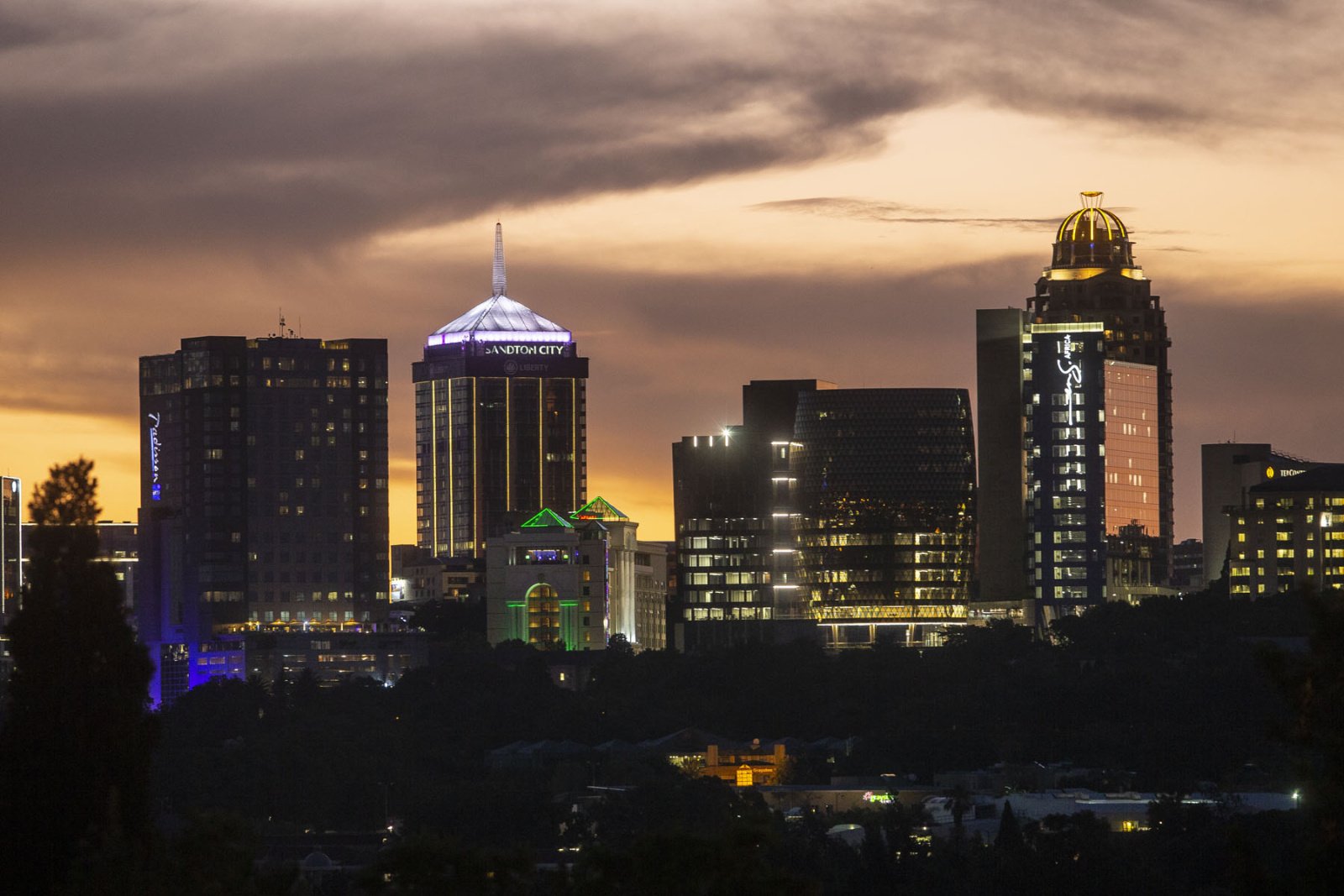
General Information
Johannesburg is the most populous city in South Africa. The City of Johannesburg itself has a population of 5,538,596, while the City of Johannesburg Metropolitan Municipality has a population of 6,599,190, making it one of the 100 largest urban areas in the world. Johannesburg is the provincial capital of Gauteng, the wealthiest province in South Africa, and seat of the country's highest court, the Constitutional Court. Situated on the mineral-rich Witwatersrand hills, the city has long been at the epicentre of the international mineral and gold trade. The richest city in Africa by GDP and private wealth, Johannesburg functions as the economic capital of South Africa and is home to the continent's largest stock exchange, the Johannesburg Stock Exchange.
- Population: 5,900,000+ (Metro Area)
- Area: 1,645 km²
- Currency: South African Rand (ZAR)
- Coordinates: Latitude: -26.204444885254, Longitude: 28.045555114746
- Timezone: Timezone info not available
- Current Local Time: ailab
Johannesburg Latest News
IOL
Western Cape MEC urges action after social service staff hijacked in Khayelitsha
Western Cape Social Development MEC Wendy Kaizer-Philander has called for greater protection for department staff after two social service professionals were hijacked in Khayelitsha while travelling to a court session in Parow on 19 October.
IOL
EFF takes Tshwane mayor to Public Protector and SAHRC over Bronkhorstspruit water crisis
The EFF has lodged complaints with the Public Protector and SAHRC over the Bronkhorstspruit water crisis, calling for investigations into alleged maladministration and possible negligence.
The Citizen
‘I don’t know what I must apologise for’: Gwede Mantashe on ‘sex-for-jobs’ remarks
ANC national chairperson Gwede Mantashe has responded to criticism of his remarks about alleged sex-for-jobs exploitation, saying the ANC Women’s League has not directly engaged with him about what he should apologise for. “I’m apologising, but I don’t know what I must apologise for,” Mantashe told SABC on Wednesday on the sidelines of the 2026 Medium-Term Budget Policy Statement (MTBPS) in Cape Town. “My understanding was that ANC Women’s League would talk to me and I would understand exactly what it is that I should apologise for,” he reiterated. Mantashe said the Women’s League had not told him what he should apologise for. In his response, he did not dispute the wording of his original remarks. Instead, he questioned which part of his remarks required an apology. “Xhosa linguists agree with me that there is nothing wrong with what I have said that requires an apology,” Mantashe said. This “apology” escalates a growing internal dispute over comments made during an ANC campaign visit in Bojanala, North West, when he was asked about allegations that a municipal councillor had demanded sexual favours from women in exchange for employment. What Mantashe said During the campaign interaction, Mantashe sought to distance the ANC from the alleged conduct, arguing that it should be treated as the conduct of an individual rather than a party matter. In remarks widely reported and circulated on social media, he said: “Don’t involve me in issues of asking for a vagina. This person asked for his vagina from a person that he encountered. This can’t be an ANC issue.” The comments drew immediate criticism from the ANC Women’s League, which described them as derogatory, gratuitously improper and inconsistent with the party’s stated values. Women’s League demands action ANCWL secretary-general Nokuthula Nqaba publicly called on Mantashe to apologise to the Newzroom Afrika journalist who asked the question and to the public. “The ANC Women’s League apologises to the Newzroom Afrika journalist and calls on comrade Gwede Mantashe to issue a public apology to both the journalist and the public for his inappropriate remarks,” Nqaba said. The league also asked the ANC to reprimand Mantashe and subject him to internal disciplinary processes over what it characterised as repeated insults and attacks on women.
The Citizen
SA’s 3% growth dream remains distant as economy battles to gain momentum
Finance Minister Enoch Godongwana remains hopeful that South Africa can achieve 3% economic growth, but for now the country must contend with an economy still struggling to gain momentum. Despite the government’s ambitions to accelerate growth, the gap between its targets and the economy’s current performance remains a major challenge. Real gross domestic product (GDP) grew 1.4% year-on-year in the first half of 2026, but contracted in the second quarter after fuel prices spiked. Godongwana forecasts real economic growth of 1.2% in 2026, down from the 1.6% projected in February. He delivered the medium-term budget policy statement (MTBPS) on Wednesday. South Africa’s economic outlook National Treasury noted that the country’s economy has shown resilience amid price and other economic shocks stemming from the conflict in the Middle East. Godongwana cautioned that a prolonged Middle East conflict, along with El Niño and its likely impact on producer costs and output, could further weaken domestic growth. “Domestic economic activity has already lost some momentum, especially in export-linked sectors,” the minister said. Economic growth is expected to reach 1.6% in 2027 and 2% by 2029, but it is still a long way from the desired 3%. South Africa’s resilience The minister said fiscal discipline and a lower inflation target are helping to contain borrowing costs and reduce the country’s risk premium. The rand has strengthened and become less volatile. “This reflects the difficult choices we have made to preserve macroeconomic stability and fiscal sustainability,” said Godongwana. “But growth remains too low.” To address slow economic growth, Godongwana has a plan. “The government is focused on accelerating implementation of structural reforms coupled with strengthening state capability and delivering public infrastructure. This will put the economy on a faster, more sustainable growth trajectory. “If we stay the course, growth could exceed 3% per annum,” he said. Municipalities blamed for sluggish economic growth National Treasury said it is addressing challenges with electricity, logistics and water; however, municipalities continue to fail to deliver basic services, hamstringing economic growth. “Longstanding constraints in electricity, logistics and water are being addressed, while local government service-delivery failures continue to limit economic growth and job creation. “Comprehensive implementation of structural reforms will benefit the growth outlook, but this requires coordinated action.” The medium-term growth strategy rests on four pillars: maintaining macroeconomic stability, implementing structural reforms, strengthening state capability and supporting growth-enhancing public infrastructure investment. Oil shock According to Treasury, the International Monetary Fund (IMF)’s October 2026 outlook forecasts South Africa’s 2026 growth at 1%, despite the oil price shock and its effects across the economy. “The IMF’s downward revision for emerging market and developing economies as a whole has been more pronounced, averaging 0.8 percentage points of lower growth. South Africa’s performance is consistent with the increased stability achieved in recent years: a lower inflation target, a narrower deficit, stabilised debt and a lower risk premium have left the economy better placed to absorb external shocks.” Treasury added that the oil price shock pushed inflation above the 3% target, and forecasts a return to the target only in 2029. “Should the shock persist, it could keep upward pressure on interest rates. In combination with the rising primary balance, lower inflation would contribute to investment, growth and job creation.” Risks to economic growth National Treasury said risks to the outlook are tilted to the downside. “A prolonged stalemate or escalation of conflict in the Middle East could keep energy prices high and inflation elevated, while a reassessment of AI investment could tighten global financial conditions. “Domestically, infrastructure bottlenecks, weak confidence and limited fiscal space leave little room to cushion further shocks. Conversely, a quicker resolution to the war, faster reforms or improved state capability could lift growth above current forecasts.” Core problem Business Leadership South Africa (BLSA) CEO Busisiwe Mavuso said the core problem remains the country’s slow economic growth. “Treasury cut its 2026 forecast to 1.2% from 1.6% in February and projects 2% only by 2029. Godongwana reaffirmed that the government’s strategy for faster growth and healthier public finances remains anchored on four pillars: maintaining macroeconomic stability, implementing structural reforms, building state capability and supporting growth-enhancing infrastructure. “Faster economic growth is the best way to address South Africa’s severe unemployment crisis. This is a long-term process, which is why every effort to accelerate delivery matters, especially on structural reforms and infrastructure.” Unemployment increased to 33.6% in the second quarter of 2026. Water challenge to be addressed Mavuso welcomed Godongwana’s reaffirmation to address water woes, which includes reducing water losses, improving revenue collection and reforming how water infrastructure is financed. In electricity, he reaffirmed that restructuring Eskom and establishing an independent transmission operator will support a more competitive market, attract new investment in generation and accelerate expansion of the grid. On infrastructure, he pointed to the new Infrastructure Finance and Implementation Support Agency, which consolidates existing units and is already supporting projects with a potential investment value of more than R207 billion. What needs to happen “Raising the rate at which the economy can sustainably grow requires maintaining macroeconomic stability and accelerating progress on structural reforms, state capability and infrastructure investment,” said Treasury. “The second-quarter contraction was driven mainly by trade rather than a broader loss of domestic demand, but growth remains well short of what is needed to durably reduce unemployment and poverty. “Inflation is above target, fiscal risks persist, and the reform agenda in energy, logistics and water remains incomplete. Sustaining resilience and turning it into durable higher growth depends on faster implementation across all four growth pillars.”
The South African
Triple murder suspect Tshuma ‘not eating or sleeping well,’ court hears
Triple murder suspect Ndodana Tshuma has reportedly been struggling to eat and sleep, prompting his lawyer to request a specialist medical assessment during his appearance at the Johannesburg Magistrate’s Court. According to reports from the court proceedings on Wednesday, 21 October, Tshuma’s lawyer, Chrispin Machingura, raised concerns about his client’s condition as the defence and state attempted to resolve outstanding issues surrounding a plea and sentencing agreement. The proceedings took a turn when Tshuma reportedly told the court that he could not remember pleading guilty or signing the document presented to him. The case was postponed to 29 October to allow further consultations between Tshuma and his legal representative, SABC News reported. lawyer requests sApecialist assessment Machingura reportedly told the court that his client had not been eating and sleeping well. He requested that Tshuma be examined by a specialist for a medical assessment. The request came as the defence sought to clarify Tshuma’s position on the plea agreement, which had been expected to be finalised during Wednesday’s proceedings. According to the reports, Tshuma maintained that he was innocent and said he could not remember pleading guilty. When his lawyer showed him the document he had signed, he reportedly said he could not recall signing it. The development raised further questions about whether the outstanding plea and sentencing arrangements could proceed as planned. The court granted a postponement to allow the defence more time to consult with Tshuma. His reported difficulties sleeping and eating should not, however, be taken as a medical diagnosis, and the request for an assessment does not establish that he has a particular condition. Why Tshuma is appearing in court Tshuma, a British national of Zimbabwean descent, is wanted in the United Kingdom in connection with the alleged murders of his wife, Zandile, and their two daughters, Natalie and Nala. He was arrested in Johannesburg in July following an international manhunt. South African proceedings include charges relating to unlawful possession of a firearm and ammunition, as well as contraventions of the Immigration Act. Tshuma had previously pleaded guilty to firearm-related and immigration offences in South Africa, with the state and defence working towards a plea and sentencing agreement. However, outstanding documentation and discrepancies delayed the finalisation of the agreement. His South African criminal proceedings are separate from the extradition process through which British authorities are seeking his return to face the murder allegations. The next court appearance on 29 October is expected to allow further consultations between Tshuma and his lawyer as the local proceedings continue.
The South African
SAPS wants YOU: Applications open for 5 500 trainees
The South African Police Service (SAPS) has opened applications for 5 500 entry-level police trainee positions for the 2026/2027 financial year. This is an opportunity for the youth of South Africa to pursue a career in law enforcement. SAPS opened the recruitment on Wednesday, 21 October and applications officially close on 13 November. #sapsHQ [YOUR FUTURE. YOUR COUNTRY. YOUR CALL: SAPS OPENS ONLINE APPLICATIONS FOR 5 500 POLICE TRAINEES]The nationwide online recruitment drive opens today, 21 October 2026, and closes on 13 November 2026.Eligible applicants who have no criminal records or pending criminal… pic.twitter.com/wB3mKUXBI2— SA Police Service 🇿🇦 (@SAPoliceService) October 21, 2026 South Africans between the ages of 18-35 are encouraged to apply, with a particular emphasis on those who are fit, disciplined and committed to serving their communities. Colonel Amanda van Wyk, the National SAPS spokesperson, said the recruitment drive aims to attract young people that are passionate about making a difference and contributing to a safer South Africa. #sapsHQ [WATCH: STEP-BY-STEP GUIDE TO SAPS ONLINE APPLICATIONS FOR 5 500 POLICE TRAINEES]The nationwide online recruitment drive opens today, 21 October 2026, and closes on 13 November 2026.Watch the video for a step-by-step guide on how to apply online and take the first… pic.twitter.com/gsyuRIac8x— SA Police Service 🇿🇦 (@SAPoliceService) October 21, 2026 HOW TO APPLY If you’re interested in applying, you can do so on the official SAPS recruitment portal here. Applicants are required to create a profile and verify their account. Once the account has been verified, the applicant needs to follow the step-by-step application process to apply for the positions. Applicants must not have a previous criminal record or a pending criminal case. Graduates are encouraged to apply. “Graduates in Law, Policing, Criminology, Law Enforcement, Forensic Investigation and Information Technology may be considered for placement within the Directorate for Priority Crime Investigation (DPCI), also known as the Hawks; Detective and Forensic Services; and Crime Intelligence,” said Van Wyk. “The targeted recruitment process will also seek to identify suitably qualified young people from underrepresented racial groups who meet the prescribed requirements.” SAPS warns against recruitment scams SAPS also emphasised applications are completely free and warned candidates against individuals demanding money in exchange for employment or promising to influence the recruitment process. Prospective applicants are encouraged to apply early and use only official SAPS recruitment channels. During the academy institution phase, all trainees receive a monthly stipend of R5 000. Upon completing basic training and advancing to the probation phase as permanent constables, officers receive a starting salary of R248 175 per annum alongside standard public service benefits. During the previous recruitment drive closing in July 2025, SAPS received 1 021 563 applications for 5 500 roles, including 334 765 tertiary graduates, highlighting severe youth unemployment in South Africa.
TechCentral
Innovex 2026: taking opportunity to where potential lives
Innovex 2026 is a free, two-day summit in Rustenburg for South African entrepreneurs.
TechCentral
Discovery ranks cybercrime as its top risk, citing frontier AI
Discovery has moved cybercrime to the top of its risk register, warning frontier AI models are speeding up attacks.